
The authors have designated this AOP as all rights reserved. Re-use in any form requires advanced permission from the authors.
AOP: 582
Title
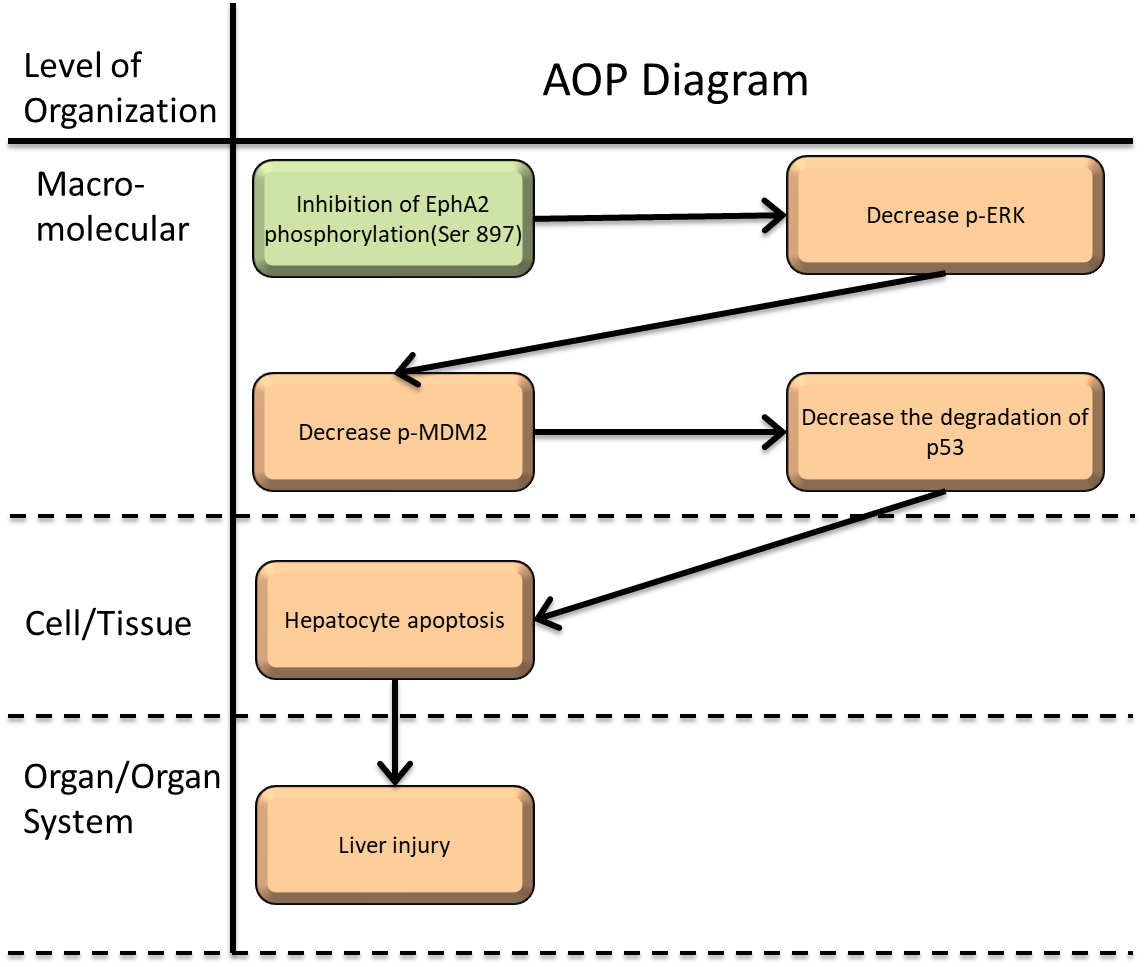
Inhibition of EphA2 phosphorylation leads to liver damage via the ERK/ MDM2/p53 axis
Short name
Graphical Representation
Additional AOP Exploration Options
Click links below to explore AOP 582, Inhibition of EphA2 phosphorylation leads to liver damage via the ERK/ MDM2/p53 axis in tools offered by third parties.

Point of Contact
Contributors
- Peihua Luo
Coaches
OECD Information Table
| OECD Project # | OECD Status | Reviewer's Reports | Journal-format Article | OECD iLibrary Published Version |
|---|---|---|---|---|
This AOP was last modified on July 10, 2025 01:43
Revision dates for related pages
| Page | Revision Date/Time |
|---|
Abstract
Drug-induced liver injury (DILI) refers to unintended hepatic damage resulting from pharmacological interventions. DILI manifests primarily through hepatocellular injury and cholestasis, wherein hepatocellular injury is predominantly mediated by regulated modes of cell death. Potential mechanisms include oxidative stress, mitochondrial dysfunction, endoplasmic reticulum (ER) stress, and DNA damage. However, universal molecular targets underlying hepatocyte toxicity remain elusive.
Among hepatotoxic agents, small molecule kinase inhibitors (SMKIs) constitute a distinct class. Unlike conventional cytotoxic chemotherapy, SMKIs demonstrate targeted anti-neoplastic efficacy with reduced systemic adverse effects. Nevertheless, SMKIs are associated with unique toxicities, notably hepatotoxicity. For instance, regorafenib, a second-line therapy for hepatocellular carcinoma, received FDA black box warnings for severe hepatotoxicity upon market release.
Based on prior evidence, a specific adverse outcome pathway (AOP) has been identified, potentially mediated by Eph receptor A2 (EphA2), a regorafenib off-target. This AOP may elucidate molecular mechanisms driving hepatotoxicity. In this AOP, the Molecular Initiating Event (MIE) is "Inhibition of EphA2 phosphorylation (Ser 897)," triggering four Key Events (KEs): "Decrease p-ERK," " Decrease p-MDM2," "Decrease the degradation of p53" and "Hepatocyte apoptosis," Ultimately, this pathway culminates in the Adverse Outcome (AO) of Liver injury.
AOP Development Strategy
Context
Strategy
Summary of the AOP
Events:
Molecular Initiating Events (MIE)
Key Events (KE)
Adverse Outcomes (AO)
Relationships Between Two Key Events (Including MIEs and AOs)
Network View
Prototypical Stressors
Life Stage Applicability
Taxonomic Applicability
Sex Applicability
Overall Assessment of the AOP
Domain of Applicability
Essentiality of the Key Events
Evidence Assessment
Known Modulating Factors
| Modulating Factor (MF) | Influence or Outcome | KER(s) involved |
|---|---|---|
Quantitative Understanding
Considerations for Potential Applications of the AOP (optional)
References
- Yan H, Wu W, Hu Y, Li J, Xu J, Chen X, Xu Z, Yang X, Yang B, He Q, Luo P. Regorafenib inhibits EphA2 phosphorylation and leads to liver damage via the ERK/MDM2/p53 axis. Nat Commun. 2023 May 13;14(1):2756.
- PMC10182995.Andrade, R.J., Chalasani, N., Björnsson, E.S. et al. Drug-induced liver injury. Nat Rev Dis Primers 5, 58 (2019).
- Hafner A, Bulyk ML, Jambhekar A, Lahav G. The multiple mechanisms that regulate p53 activity and cell fate. Nat Rev Mol Cell Biol. 2019 Apr;20(4):199-210.
- Haupt Y, Maya R, Kazaz A, Oren M. Mdm2 promotes the rapid degradation of p53. Nature. 1997 May 15;387(6630):296-9.
- Zhou BP, Liao Y, Xia W, Zou Y, Spohn B, Hung MC. HER-2/neu induces p53 ubiquitination via Akt-mediated MDM2 phosphorylation. Nat Cell Biol. 2001 Nov;3(11):973-82.
- Cui XD, Lee MJ, Kim JH, Hao PP, Liu L, Yu GR, Kim DG. Activation of mammalian target of rapamycin complex 1 (mTORC1) and Raf/Pyk2 by growth factor-mediated Eph receptor 2 (EphA2) is required for cholangiocarcinoma growth and metastasis. Hepatology. 2013 Jun;57(6):2248-60.
- Malmlöf M, Roudier E, Högberg J, Stenius U. MEK-ERK-mediated phosphorylation of Mdm2 at Ser-166 in hepatocytes. Mdm2 is activated in response to inhibited Akt signaling. J Biol Chem. 2007 Jan 26;282(4):2288-96. doi: 10.1074/jbc.M604953200. Epub 2006 Nov 15. Erratum in: J Biol Chem. 2016 Dec 16;291(51):26588.