
The authors have designated this AOP as all rights reserved. Re-use in any form requires advanced permission from the authors.
AOP: 583
Title
Vascular endothelial HER2 inhibition disrupts cardiomyocyte calcium homeostasis via EGFR/STAT3/PTX3 axis leading to cardiac contractile dysfunction
Short name
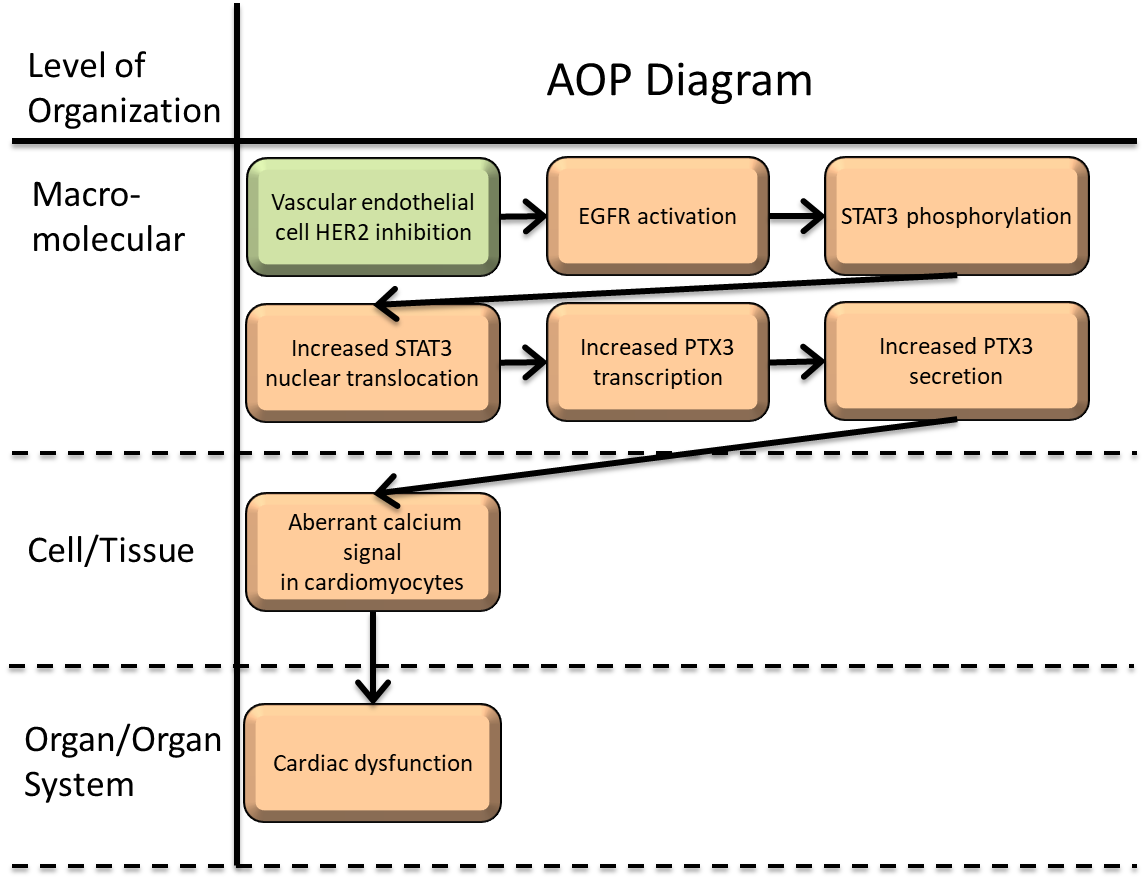
Graphical Representation
Additional AOP Exploration Options
Click links below to explore AOP 583, Vascular endothelial HER2 inhibition disrupts cardiomyocyte calcium homeostasis via EGFR/STAT3/PTX3 axis leading to cardiac contractile dysfunction in tools offered by third parties.

Point of Contact
Contributors
- Peihua Luo
Coaches
OECD Information Table
| OECD Project # | OECD Status | Reviewer's Reports | Journal-format Article | OECD iLibrary Published Version |
|---|---|---|---|---|
This AOP was last modified on July 10, 2025 01:48
Revision dates for related pages
| Page | Revision Date/Time |
|---|
Abstract
Cardiotoxicity denotes a prevalent adverse drug reaction encompassing direct structural damage, diastolic impairment, arrhythmias, vascular dysfunction, hemodynamic alterations, and compromised stress response. Established mechanisms include mitochondrial dysfunction, inhibition of cardiomyocyte survival pathways, fibrosis, impaired nitric oxide synthesis, and calcium cycling dysregulation. However, upstream molecular drivers of cardiotoxicity require further elucidation.
Monoclonal antibodies, exemplified by trastuzumab, represent a cardiotoxic drug class with high bioconversion efficiency. Trastuzumab targets human epidermal growth factor receptor 2 (HER2), demonstrating efficacy against HER2-overexpressing malignancies but concurrently elevating cardiovascular risk.
An adverse outcome pathway (AOP) has been proposed, potentially mediated by vascular endothelial HER2 inhibition. This AOP may clarify molecular mechanisms underlying cardiotoxicity. In this AOP, the Molecular Initiating Event (MIE) is " Vascular endothelial cell HER2 inhibition," triggering six Key Events (KEs): " EGFR activation, " " STAT3 phosphorylation, " " Increased STAT3 nuclear translocation, " " Increased PTX3 transcription, " "Increased PTX3 secretion, " and "Aberrant calcium signal in cardiomyocytes. " Ultimately, this pathway culminates in the Adverse Outcome (AO) of Cardiac dysfunction.
AOP Development Strategy
Context
Strategy
Summary of the AOP
Events:
Molecular Initiating Events (MIE)
Key Events (KE)
Adverse Outcomes (AO)
Relationships Between Two Key Events (Including MIEs and AOs)
Network View
Prototypical Stressors
Life Stage Applicability
Taxonomic Applicability
Sex Applicability
Overall Assessment of the AOP
Domain of Applicability
Essentiality of the Key Events
Evidence Assessment
Known Modulating Factors
| Modulating Factor (MF) | Influence or Outcome | KER(s) involved |
|---|---|---|
Quantitative Understanding
Considerations for Potential Applications of the AOP (optional)
References
- Xu Z, Gao Z, Fu H, Zeng Y, Jin Y, Xu B, Zhang Y, Pan Z, Chen X, Zhang X, Wang X, Yan H, Yang X, Yang B, He Q, Luo P. PTX3 from vascular endothelial cells contributes to trastuzumab-induced cardiac complications. Cardiovasc Res. 2023 May 22;119(5):1250-1264.
- Mamoshina P, Rodriguez B, Bueno-Orovio A. Toward a broader view of mechanisms of drug cardiotoxicity. Cell Rep Med. 2021 Mar 16;2(3):100216.
- Carrizzo A, Lenzi P, Procaccini C, Damato A, Biagioni F, Ambrosio M, Amodio G, Remondelli P, Del Giudice C, Izzo R, Malovini A, Formisano L, Gigantino V, Madonna M, Puca AA, Trimarco B, Matarese G, Fornai F, Vecchione C. Pentraxin 3 Induces Vascular Endothelial Dysfunction Through a P-selectin/Matrix Metalloproteinase-1 Pathway. Circulation. 2015 Apr 28;131(17):1495-505; discussion 1505.
- Avalle L, Camporeale A, Morciano G, Caroccia N, Ghetti E, Orecchia V, Viavattene D, Giorgi C, Pinton P, Poli V. STAT3 localizes to the ER, acting as a gatekeeper for ER-mitochondrion Ca2+ fluxes and apoptotic responses. Cell Death Differ. 2019 May;26(5):932-942.
- Shraim BA, Moursi MO, Benter IF, Habib AM, Akhtar S. The Role of Epidermal Growth Factor Receptor Family of Receptor Tyrosine Kinases in Mediating Diabetes-Induced Cardiovascular Complications. Front Pharmacol. 2021 Aug 2; 12:701390.
Makki N, Thiel KW, Miller FJ Jr. The epidermal growth factor receptor and its ligands in cardiovascular disease. Int J Mol Sci. 2013 Oct 15;14(10):20597-613.