
The authors have designated this AOP as all rights reserved. Re-use in any form requires advanced permission from the authors.
AOP: 620
Title
The Adverse Outcome Pathway to Deposition of Energy Leading to Female Decreased Fertility
Short name
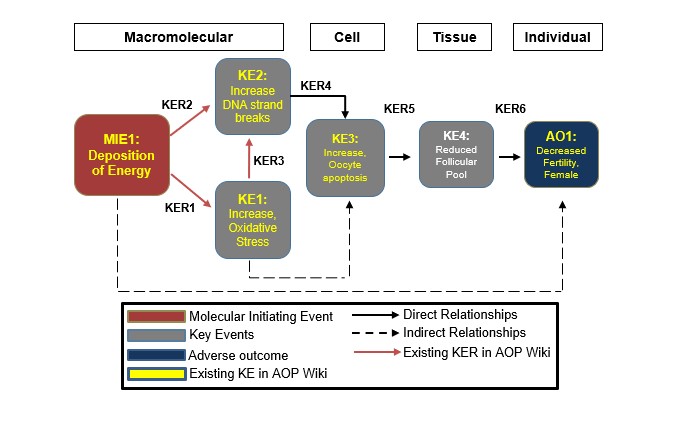
Graphical Representation
Additional AOP Exploration Options
Click links below to explore AOP 620, The Adverse Outcome Pathway to Deposition of Energy Leading to Female Decreased Fertility in tools offered by third parties.

Point of Contact
Contributors
- Jessica D'Urbano
- Saadia Khilji
- Vinita Chauhan
- Awurakua Asamoah-Mensah
Coaches
OECD Information Table
| OECD Project # | OECD Status | Reviewer's Reports | Journal-format Article | OECD iLibrary Published Version |
|---|---|---|---|---|
This AOP was last modified on October 05, 2026 09:34
Revision dates for related pages
| Page | Revision Date/Time |
|---|
Abstract
Infertility is a disorder of the reproductive system defined by the inability to conceive after 12 months of regular, unprotected intercourse. Ionizing radiation is known to exert gonadotoxic effects, impacting female fertility by damaging reproductive organs or disrupting the hypothalamic-pituitary-gonadal axis. These effects can lead to ovarian insufficiency, pubertal arrest, and infertility, with severity depending on radiation dose and the individual's age. As space missions extend in duration and distance, understanding the effects of space radiation on female fertility becomes increasingly critical, not only for the individual but also for potential impacts on future generations. To address this need, International Space Agencies, in collaboration with Health Canada and the Nuclear Energy Agency, are developing an Adverse Outcome Pathway (AOP) to consolidate knowledge on radiation-induced infertility in females. This initiative complements existing AOPs addressing space-related health risks such as cataracts, vascular remodelling, bone loss, and cognitive impairments. The proposed AOP uses scoping review methodology combined with expert consultation to identify the limited but growing literature, drawing from invitro studies, animal models and past spaceflight missions.The hypothetical AOP links deposition of energy as the molecular initiating event (MIE) to a series of measurable key events (KEs) including oxidative stress, DNA damage, oocyte apoptosis, and reduced follicular pool ultimately leading to infertility. These events align with AOPs 238, 311, and 396 in the AOP-Wiki (www.aopwiki.org). The resulting AOP can inform risk assessment, identify biomarkers, guide countermeasure development, and support multi-stressor risk evaluations. Its broader applicability may also enhance our understanding of infertility caused by chemical exposures, providing a valuable tool for space medicine and environmental toxicology.
AOP Development Strategy
Context
Strategy
Summary of the AOP
Events:
Molecular Initiating Events (MIE)
Key Events (KE)
Adverse Outcomes (AO)
Relationships Between Two Key Events (Including MIEs and AOs)
Network View
Prototypical Stressors
Life Stage Applicability
Taxonomic Applicability
Sex Applicability
Overall Assessment of the AOP
Domain of Applicability
Essentiality of the Key Events
Evidence Assessment
Known Modulating Factors
| Modulating Factor (MF) | Influence or Outcome | KER(s) involved |
|---|---|---|