
This Key Event Relationship is licensed under the Creative Commons BY-SA license. This license allows reusers to distribute, remix, adapt, and build upon the material in any medium or format, so long as attribution is given to the creator. The license allows for commercial use. If you remix, adapt, or build upon the material, you must license the modified material under identical terms.
Relationship: 3716
Title
Increase, Gonadotropins concentration in plasma leads to Increased, E2 production in ovaries
Upstream event
Downstream event
Key Event Relationship Overview
AOPs Referencing Relationship
| AOP Name | Adjacency | Weight of Evidence | Quantitative Understanding | Point of Contact | Author Status | OECD Status |
|---|---|---|---|---|---|---|
| Activation, estrogen receptor alpha leads to persistent vaginal cornification via increased kisspeptin release | adjacent | High | John Frisch (send email) | Under development: Not open for comment. Do not cite | ||
| Activation, estrogen receptor alpha leads to increased uterine weight via earlier proliferation of cells of the uterine lining | adjacent | High | John Frisch (send email) | Under development: Not open for comment. Do not cite | ||
| Activation, estrogen receptor alpha leads to precocious puberty via increased kisspeptin release | adjacent | High | John Frisch (send email) | Under development: Not open for comment. Do not cite | ||
| Activation, estrogen receptor alpha leads to decreased fertility via prolonged estrus cycle | adjacent | High | John Frisch (send email) | Under development: Not open for comment. Do not cite |
Taxonomic Applicability
| Term | Scientific Term | Evidence | Link |
|---|---|---|---|
| mammals | mammals | Moderate | NCBI |
Sex Applicability
| Sex | Evidence |
|---|---|
| Female | High |
Life Stage Applicability
| Term | Evidence |
|---|---|
| Adult, reproductively mature | Moderate |
| Juvenile | Moderate |
Key Event Relationship Description
Gonadotropins are hormones in mammals that cue development of reproductive organs to maturity (Casarini and Simoni 2021; Howard 2021) and the different phases of the estrus cycle (Uenoyama et al. 2021). Gonadotropins are composed of two subunits: a 90-100 amino acid alpha subunit that is identical for all gonadotropins for a species, and a 105-150 amino acid beta subunit that are unique to each gonadotropin but exhibit large similarities in order to interact with alpha subunits (Cahoreau et al 2015). Follicle-stimulating hormone (FSH) and Luteinizing hormone (LH) are gonadotropins of particular interest because of roles in the hypothalamus- pituitary-gonadal (HPG) axis, and are released from the anterior pituitary gland (Howard 2021), resulting in increased production of estradiol in the ovaries.
Production of estradiol (E2) by the ovaries has been well-established by the two-cell, two gonadotropin model of steroid biosynthesis (for review see Drummond 2006; Kimura et al. 2007; Palermo 2007; Beevors et al. 2024). Luteinizing hormone stimulates steroid production in theca cells, with follicle-stimulating hormone stimulates steroid production in granulosa cells.
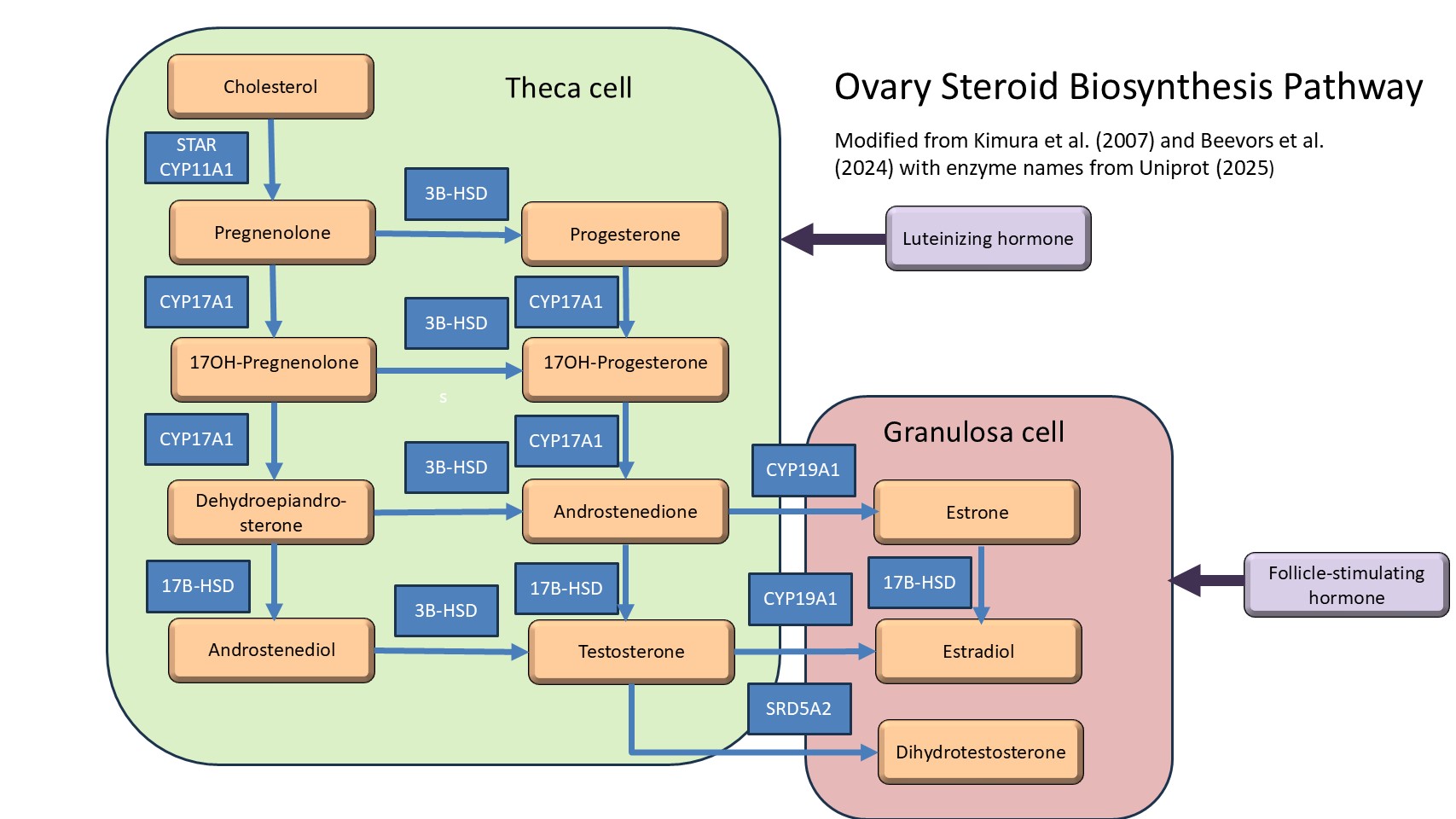
Table 1: List of steroid synthesis enzymes with identifier of enzyme (Uniprot, 2025).
|
Enzyme |
Identifier |
|
Steroidogenic acute regulatory protein, mitochondrial (STAR) |
|
|
Cholesterol side-chain cleavage enzyme, mitochondrial (CYP11A) |
EC:1.14.15.6 |
|
3 beta-hydroxysteroid dehydrogenase (3B-HSD) |
EC:1.1.1.145 |
|
Steroid 17-alpha-hydroxylase (CYP17A1) |
EC:1.14.14.19 |
|
17-beta-hydroxysteroid dehydrogenase (17B-HSD) |
EC:1.1.1.105 |
|
Aromatase (CYP19A1) |
EC:1.14.14.14 |
|
3-oxo-5-alpha-steroid 4-dehydrogenase 2 (SRD5A2) |
EC:1.3.1.22 |
Evidence Collection Strategy
This Key Event Relationship was part of an Environmental Protection Agency effort to develop AOPs that establish scientifically supported causal linkages between alternative endpoints measured using new approach methodologies (NAMs) and guideline apical endpoints measured in Tier 1 and Tier 2 test guidelines (U.S. EPA, 2025) employed by the Endocrine Disruptor Screening Program (EDSP). A series of key events that represent significant, measurable, milestones connecting molecular initiation to apical endpoints indicative of adversity were identified based on scientific review articles and empirical studies. Additionally, scientific evidence supporting the causal relationships between each pair of key events was assembled and evaluated. The present effort focused primarily on empirical studies with laboratory rodents and other mammals.
Empirical studies are focused on increased fast Luteinizing hormone/ Follicle-stimulating hormone (LH/FSH) pulsatile release and resulting increased estradiol production in ovaries, in support of development of AOP 623.
Authors of KER 3716 did a further evaluation of published peer-reviewed literature to provide additional evidence in support of the key event relationship. The literature used to support this KER began with the test guidelines and followed to primary, secondary, and/or tertiary works concerning the relevant underlying biology. In addition, search engines were used to target journal articles with terms ‘Luteinizing hormone,’ ‘Follicle-stimulating hormone,’ and ‘Estradiol’ to locate representative empirical studies that support the key event relationship.
Following initial human effort in AOP development, artificial Intelligence (AI)-assisted literature search and synthesis, using EPA-AI GPT5, was used to identify additional literature, and draft Uncertainties and Inconsistencies content of this KER page. Additionally, EPA-AI GPT5 was also used to check for additional text improvement in other sections. All content generated through this process were reviewed and verified by the KER author against literature sources, prior to inclusion.
Evidence Supporting this KER
Biological Plausibility
Increased Luteinizing hormone/ Follicle-stimulating hormone (LH/FSH) levels and resulting increased estradiol production in ovaries have been studied in laboratory mammals by addition of hormones (Sashida and Johnson 1976; Spears et al. 1998; Murray et al. 2008). In vitro studies isolating ovarian follicles have been useful in isolating the essentiality of gonadotropins by selective addition (Spears et al. 1998; Murray et al. 2008). Luteinizing hormone binds to receptors on the surface of theca cells, while follicle-stimulating hormone binds to receptors on granulosa cells, cueing cyclic adenosine monophosphate (cAMP) signalling cascades in each cell that results in increased production of enzymes needed for conversion of cholesterol precursor to steroid compounds. Theca cells and granulosa cells are responsible for different enzyme-catalyzed reaction steps resulting in the generation of estradiol.
Empirical Evidence
|
Species |
Duration |
Dose |
Increased LH/FSH? |
Increased E2 production ovaries? |
Summary |
Citation |
|
Rats (Rattus norvegicus) |
24 hours |
10 ug/L FSH and 1 ug/L LH at 2 hour intervals. |
yes |
yes |
Injection of female rats with FSH and LH led to increased estradiol production in ovaries indirectly indicated by increased plasma estradiol. |
Sashida and Johnson (1976) |
|
Mice (Mus musculus) |
5 days |
In vitro ovaries 5 IU FSH |
yes |
yes |
Female mice ovary follicles exposed to FSH led to statistically significant increased estradiol. |
Spears et al. (1998) |
|
Mice (Mus musculus) |
6 days |
In vitro ovaries 5 IU FSH + 0.01, 0.05 IU LH |
yes |
yes |
Female mice ovary follicles need to be exposed to both FSH and LH in order to lead to statistically significant increased estradiol. |
Murray et al. (2008) |
Uncertainties and Inconsistencies
- Different response to Follicle-stimulating hormone (FSH) and Luteinizing hormone (LH).
- Increased Luteinizing hormone (LH) binds to theca cells in ovaries, while Follicle-stimulating hormone (FSH) binds to granulosa cells in ovaries; although both gonadotropins stimulate enzyme production, different enzyme-catalyzed reactions involving different intermediates for estradiol production occur in theca cells versus granulosa cells (Kimura et al. 2007; Casaroni and Simoni 2021; Beevors et al. 2024). Investigations should recognize the different activities in theca cells and granulosa cells, when monitoring levels of LH, FSH, and estradiol.
Known modulating factors
Quantitative Understanding of the Linkage
Response-response Relationship
Time-scale
Known Feedforward/Feedback loops influencing this KER
Domain of Applicability
Life Stage: Applies to adult, reproductively mature and juveniles.
Sex: Applies to females as specific to ovaries.
Taxonomic: Primarily studied in humans and laboratory rodents. Plausible for most mammals due to conserved hormone pathways regulating hypothalamus-pituitary-gonadal axis processes. Gonadotropins and estradiol production in ovaries widespread among vertebrates, including fish, amphibians, reptiles, birds, and mammals (Bondesson et al. 2015; Li et al. 2019; Hollander-Cohen et al. 2021; Hanlon et al. 2022; Cruz-Cano et al. 2023).
References
Beevors LI, Sundar S, Foster PA. 2024. Steroid metabolism and hormonal dynamics in normal and malignant ovaries. Essays in Biochemistry 68(4): 491-507.
Bondesson M, Hao R, Lin CY, Williams C, Gustafsson JA. 2015. Estrogen receptor signaling during vertebrate development. Biochimica et Biophysica Acta 1849(2): 142-151.
Cahoreau C, Klett D, Combarnous Y. 2015. Structure-function relationships of glycoprotein hormones and their subunits' ancestors. Frontiers in Endocrinology 6: 26.
Casarini, L. and Simoni M. 2021. Recent advances in understanding gonadotropin signaling. Faculty Reviews 10: 41.
Cruz-Cano NB, Sanchez-Rivera UA, Alvarez-Rodriguez C, Cardenas-Leon M, Martinez-Torres M. 2023. Sex steroid receptors in the ovarian follicles of the lizard Sceloporus torquatus. Zygote. 31(4): 386-392.
Drummond AE. 2006. The role of steroids in follicular growth. Reproductive Biology and Endocrinology 4:16.
Hanlon C, Ziezold CJ, Bedecarrats GY. 2022. The Diverse Roles of 17β-Estradiol in Non-Gonadal Tissues and Its Consequential Impact on Reproduction in Laying and Broiler Breeder Hens. Frontiers in Physiology 13: 942790.
Hollander-Cohen L, Golan M, Levavi-Sivan B. 2021. Differential Regulation of Gonadotropins as Revealed by Transcriptomes of Distinct LH and FSH Cells of Fish Pituitary. International Journal of Molecular Sciences 22(12): 6478.
Howard, S.R. 2021. Interpretation of reproductive hormones before, during and after the pubertal transition—identifying health and disordered puberty. Clinical Endocrinolology 95: 702-715.
Kimura S, Matsumoto T, Matsuyama R, Shiina H, Sato T, Takeyama K, Kato S. 2007. Androgen receptor function in folliculogenesis and its clinical implication in premature ovarian failure. Trends in Endocrinology and Metabolism 18(5): 183-189.
Li M, Sun L, Wang D. 2019. Roles of estrogens in fish sexual plasticity and sex differentiation. General and Comparative Endocrinology 277: 9-16.
Murray AA, Swales AK, Smith RE, Molinek MD, Hillier SG, Spears N. 2008. Follicular growth and oocyte competence in the in vitro cultured mouse follicle: effects of gonadotrophins and steroids. MHR-Basic Science of Reproductive Medicine 14(2): 75-83.
Palermo R. 2007. Differential actions of FSH and LH during folliculogenesis. Reproductive BioMedicine Online 15(3): 326-337.
Sashida T, Johnson DC. 1976. Stimulation of the estrogen synthesizing system of the immature rat ovary by exogenous and endogenous gonadotropins. Steroids 27(4): 469-79.
Spears N, Murray AA, Allison V, Boland NI, Gosden RG. 1998. Role of gonadotrophins and ovarian steroids in the development of mouse follicles in vitro. Journal of Reproduction and Fertility 113(1): 19-26.
Uenoyama, Y., Inoue, N., Nakamura, S., and Tsukamura, H. Kisspeptin Neurons and Estrogen–Estrogen Receptor α Signaling: Unraveling the Mystery of Steroid Feedback System Regulating Mammalian Reproduction. 2021. International Journal of Molecular Sciences 22(17): 9229.
U.S. Environmental Protection Agency. 2025. EDSP Test Guidelines and Guidance Document. https://www.epa.gov/test-guidelines-pesticides-and-toxic-substances/edsp-test-guidelines-and-guidance-document (retrieved 25 July 2025).
The UniProt Consortium. UniProt: the Universal Protein Knowledgebase in 2025. https://www.uniprot.org/ (retrieved 2 November 2025).
Italics indicate edits from John Frisch February 2026. A full list of updates can be found in the Change Log on the View History page.