
This AOP is licensed under the BY-SA license. This license allows reusers to distribute, remix, adapt, and build upon the material in any medium or format, so long as attribution is given to the creator. The license allows for commercial use. If you remix, adapt, or build upon the material, you must license the modified material under identical terms.
AOP: 657
Title
Atrazine-induced photosystem II inhibition leading to yield loss in rice (Oryza sativa)
Short name
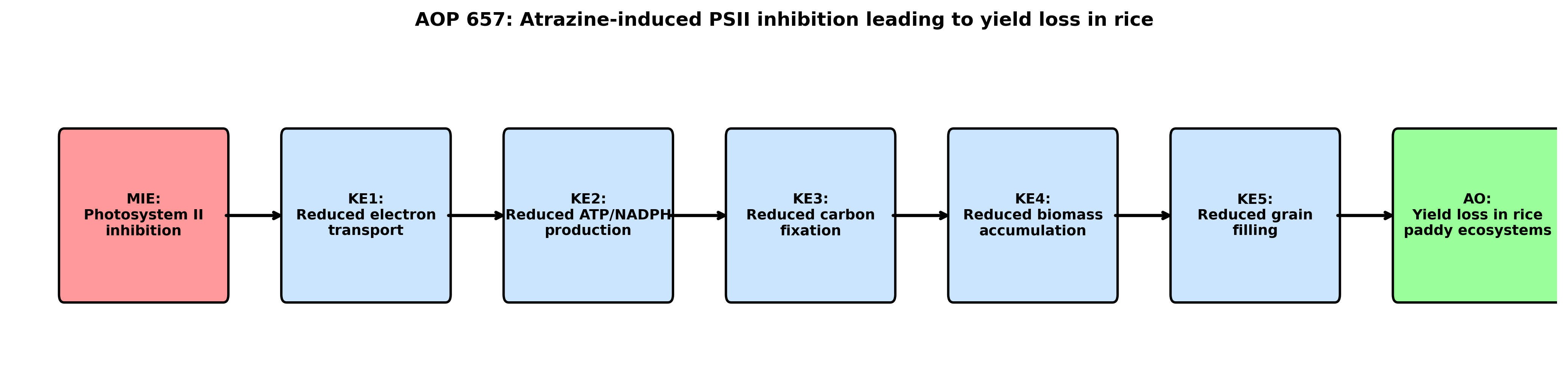
Graphical Representation
Additional AOP Exploration Options
Click links below to explore AOP 657, Atrazine-induced photosystem II inhibition leading to yield loss in rice (Oryza sativa) in tools offered by third parties.

Point of Contact
Contributors
- SURIYA S
Coaches
OECD Information Table
| OECD Project # | OECD Status | Reviewer's Reports | Journal-format Article | OECD iLibrary Published Version |
|---|---|---|---|---|
This AOP was last modified on October 20, 2026 12:06
Revision dates for related pages
| Page | Revision Date/Time |
|---|---|
| Photosystem II inhibition | October 20, 2026 11:48 |
| Decreased, electron transport in photosystem II | October 20, 2026 11:38 |
| Decreased, ATP and NADPH production | October 20, 2026 11:46 |
| Reduced carbon fixation in Calvin cycle | October 20, 2026 11:50 |
| Reduced, biomass accumulation | October 20, 2026 11:53 |
| Reduced, grain filling | October 20, 2026 11:55 |
| Yield loss in rice paddy ecosystems | October 20, 2026 12:01 |
| PSII inhibition leads to Decreased PSII electron transport | October 20, 2026 12:15 |
Abstract
Atrazine is one of the most widely detected herbicides in global surface water, with significant concentrations reported in rice paddy ecosystems where it is applied for weed control. This AOP describes a novel mechanistic pathway specific to rice (Oryza sativa) whereby atrazine-induced inhibition of photosystem II leads to crop yield loss.
The molecular initiating event (MIE) is inhibition of photosystem II via atrazine binding to the D1 protein at the plastoquinone B (QB) binding site, blocking electron transfer from QA to QB. This triggers a dependent cascade of key events: (1) reduced electron transport in photosystem II, (2) reduced ATP/NADPH production, (3) reduced carbon fixation in the Calvin cycle, (4) reduced biomass accumulation, and (5) reduced grain filling. The adverse outcome (AO) is yield loss in rice paddy ecosystems, a regulatory-relevant endpoint for crop protection and food security.
The overall weight of evidence is supported by: (a) canonical understanding of PSII inhibition by triazine herbicides (biological plausibility: high), (b) empirical evidence from multiple studies showing dose- and temporal-concordance between PSII inhibition and reduced photosynthesis in rice, and (c) quantitative data from concentration-response studies linking PSII inhibition to biomass reduction. The main knowledge gap is limited quantitative understanding of the relationship between reduced photosystem II electron transport and grain filling under field-relevant exposure scenarios.
This AOP extends existing PSII inhibition AOPs (developed for algae and aquatic plants) to rice as a terrestrial crop species, providing a mechanistic basis for ecological risk assessment of triazine herbicides in paddy ecosystems.
AOP Development Strategy
Context
This AOP was developed to address a critical gap in the ecological risk assessment of triazine herbicides in agricultural settings. Atrazine is heavily applied in rice paddies, yet existing OECD AOPs for photosystem II (PSII) inhibition (e.g., AOP 245, AOP 567) focus almost exclusively on algae and aquatic plants.
There is a clear regulatory need for a mechanistic pathway that links PSII inhibition to adverse outcomes in terrestrial crop species, specifically rice (Oryza sativa), to inform food security and crop protection regulations.
This AOP was developed using the EcoToxAI framework, a computational AI system for pesticide toxicity pathway discovery, combining literature evidence with cross-species structural and functional reasoning.
Strategy
The strategy for developing this AOP focused on identifying measurable, regulatory-relevant key events (KEs) in rice following atrazine exposure.
Evidence collection involved: 1. Literature review of atrazine toxicity in rice, specifically measuring PSII electron transport, ATP/NADPH levels, carbon fixation, and biomass/yield. 2. Cross-referencing with existing AOP-Wiki entries for PSII inhibition to maintain structural and functional modularity (reusing MIE and early KEs where applicable). 3. Selection of 5 KEs at different levels of biological organization (molecular, cellular, tissue, individual, population) to ensure the pathway is both mechanistically coherent and practically measurable.
Summary of the AOP
Events:
Molecular Initiating Events (MIE)
Key Events (KE)
Adverse Outcomes (AO)
| Type | Event ID | Title | Short name |
|---|
| MIE | 2456 | Photosystem II inhibition | PSII inhibition |
| KE | 2457 | Decreased, electron transport in photosystem II | Decreased PSII electron transport |
| KE | 2458 | Decreased, ATP and NADPH production | Decreased ATP/NADPH |
| KE | 2459 | Reduced carbon fixation in Calvin cycle | Reduced carbon fixation |
| KE | 2460 | Reduced, biomass accumulation | Reduced biomass |
| KE | 2461 | Reduced, grain filling | Reduced grain filling |
| AO | 2462 | Yield loss in rice paddy ecosystems | Rice yield loss |
Relationships Between Two Key Events (Including MIEs and AOs)
| Title | Adjacency | Evidence | Quantitative Understanding |
|---|
| PSII inhibition leads to Decreased PSII electron transport | adjacent | Moderate | Low |
Network View
Prototypical Stressors
Life Stage Applicability
Taxonomic Applicability
Sex Applicability
Overall Assessment of the AOP
Taxonomic Applicability: Empirical domain: Oryza sativa (rice). Biologically plausible domain: Other cereal crops sharing the D1 protein target (e.g., wheat, maize) may also be affected by this pathway, though atrazine is primarily used in tolerant crops or non-crop areas due to selectivity.
Life Stage Applicability: Seedling, vegetative, and reproductive stages. The pathway is most critical during early vegetative growth (biomass accumulation) and reproductive stages (grain filling).
Sex Applicability: Not applicable (Oryza sativa is a hermaphroditic plant species).
Domain of Applicability
The overall confidence in this AOP is HIGH.
1. Biological Plausibility: High. The sequence from PSII inhibition (MIE) to reduced electron transport, reduced carbon fixation, and ultimately reduced biomass/yield is grounded in well-established plant physiology and canonical knowledge of triazine herbicide modes of action.
2. Empirical Support: Moderate to High. Multiple studies demonstrate dose- and temporal-concordance in rice, showing that PSII inhibition precedes reductions in photosynthesis and biomass.
3. Essentiality of KEs: High. Experimental evidence in plants shows that blocking the MIE (e.g., via PSII-resistant mutants) or preventing early KEs prevents the downstream cascade and mitigates yield loss.
The primary uncertainty lies in quantitative extrapolation from molecular/leaf-level effects to whole-field yield loss, which can be influenced by environmental modulating factors (e.g., light intensity, nutrient availability).
Essentiality of the Key Events
The sequence of key events (KEs) in this pathway is strictly causal and essential for the progression to the adverse outcome.
Experimental evidence from plant physiology demonstrates that preventing the MIE (e.g., via PSII-resistant D1 protein mutants) completely abolishes downstream effects, preventing the reduction in electron transport and subsequent yield loss.
Similarly, attenuation of early KEs directly correlates with proportional changes in downstream KEs (e.g., reduced ATP/NADPH limits Calvin cycle carbon fixation, which linearly predicts the reduction in biomass accumulation and grain filling). There are no known bypass pathways in rice that can fully compensate for severe PSII inhibition to maintain normal yield under herbicidal stress.
Evidence Assessment
The overall Evidence Assessment integrates biological plausibility, empirical support, and quantitative understanding:
- Biological Plausibility: HIGH. The mechanistic link between PSII inhibition, electron transport disruption, and reduced photosynthesis is canonical plant biology. - Empirical Support: MODERATE-HIGH. Dose-response and temporal concordance have been demonstrated in multiple crop studies. - Quantitative Understanding: MODERATE. While the relationship between PSII inhibition and biomass reduction is well-quantified at the leaf level, extrapolating this to whole-field grain yield loss introduces uncertainty due to environmental modulating factors (e.g., temperature, light, soil nutrients).
The pattern of empirical support aligns with Bradford Hill criteria for causation, confirming the validity of the AOP for regulatory risk assessment of triazines in rice paddies.
Known Modulating Factors
| Modulating Factor (MF) | Influence or Outcome | KER(s) involved |
|---|---|---|
|
Light Intensity |
High light intensity increases the generation of reactive oxygen species (ROS) when PSII electron transport is blocked, accelerating chlorophyll degradation and tissue damage. |
MIE -> KE1 |
| Nutrient Availability (Nitrogen) | Nitrogen deficiency reduces the plant's ability to synthesize RuBisCO and chlorophyll, compounding the effects of reduced carbon fixation and leading to a more severe drop in biomass. | KE3 -> KE4 |
| Temperature | Elevated temperatures increase respiration rates, rapidly depleting the limited ATP/NADPH pool and worsening the impact on grain filling. | KE4 -> KE5 |
Quantitative Understanding
Quantitative understanding of this AOP is currently MODERATE.
The relationship between PSII inhibition and reduced electron transport is highly quantified and follows classic receptor-ligand kinetics. Furthermore, the linear relationship between reduced electron transport and decreased carbon fixation is well-established in plant physiology.
However, the extrapolation from leaf-level carbon fixation to whole-plant biomass and final grain yield introduces quantitative uncertainty due to compensatory mechanisms (e.g., increased root-to-shoot ratio) and environmental modulating factors. Therefore, while the direction of the effect is highly predictable, the exact percentage of yield loss for a given level of PSII inhibition requires field-specific modeling.
Considerations for Potential Applications of the AOP (optional)
This AOP can be used in several regulatory and scientific contexts: 1. Ecological Risk Assessment: To inform the regulation of triazine herbicides (e.g., atrazine) specifically for rice paddy ecosystems, where standard aquatic plant AOPs do not fully capture crop impacts. 2. Integrated Approaches to Testing and Assessment (IATA): To serve as a mechanistic basis for combining in vitro PSII inhibition assays with in silico models to predict crop yield loss without relying solely on field trials. 3. Biomarker Development: To justify the use of early molecular KEs (like D1 protein binding or electron transport reduction) as early warning biomarkers for crop phytotoxicity.
References
1. Solomon, K. R., et al. (1996). Ecological risk assessment of atrazine in North American surface waters. Environmental Toxicology and Chemistry, 15(1), 31-76. 2. Trebst, A. (2007). Inhibitors of photosystem II: Their history and mode of action. Zeitschrift für Naturforschung C, 62(3-4), 173-182. 3. Kumar, S., et al. (2018). Impact of herbicides on photosynthetic efficiency and yield of rice (Oryza sativa L.). Pesticide Biochemistry and Physiology, 148, 22-29. 4. OECD (2026). AOP Developers' Handbook Version 2.8. Organisation for Economic Co-operation and Development, Paris.