
This AOP is licensed under the BY-SA license. This license allows reusers to distribute, remix, adapt, and build upon the material in any medium or format, so long as attribution is given to the creator. The license allows for commercial use. If you remix, adapt, or build upon the material, you must license the modified material under identical terms.
AOP: 612
Title
Peroxisome proliferator-activated receptor alpha activation leading to early life stage mortality via reduced adenosine triphosphate
Short name
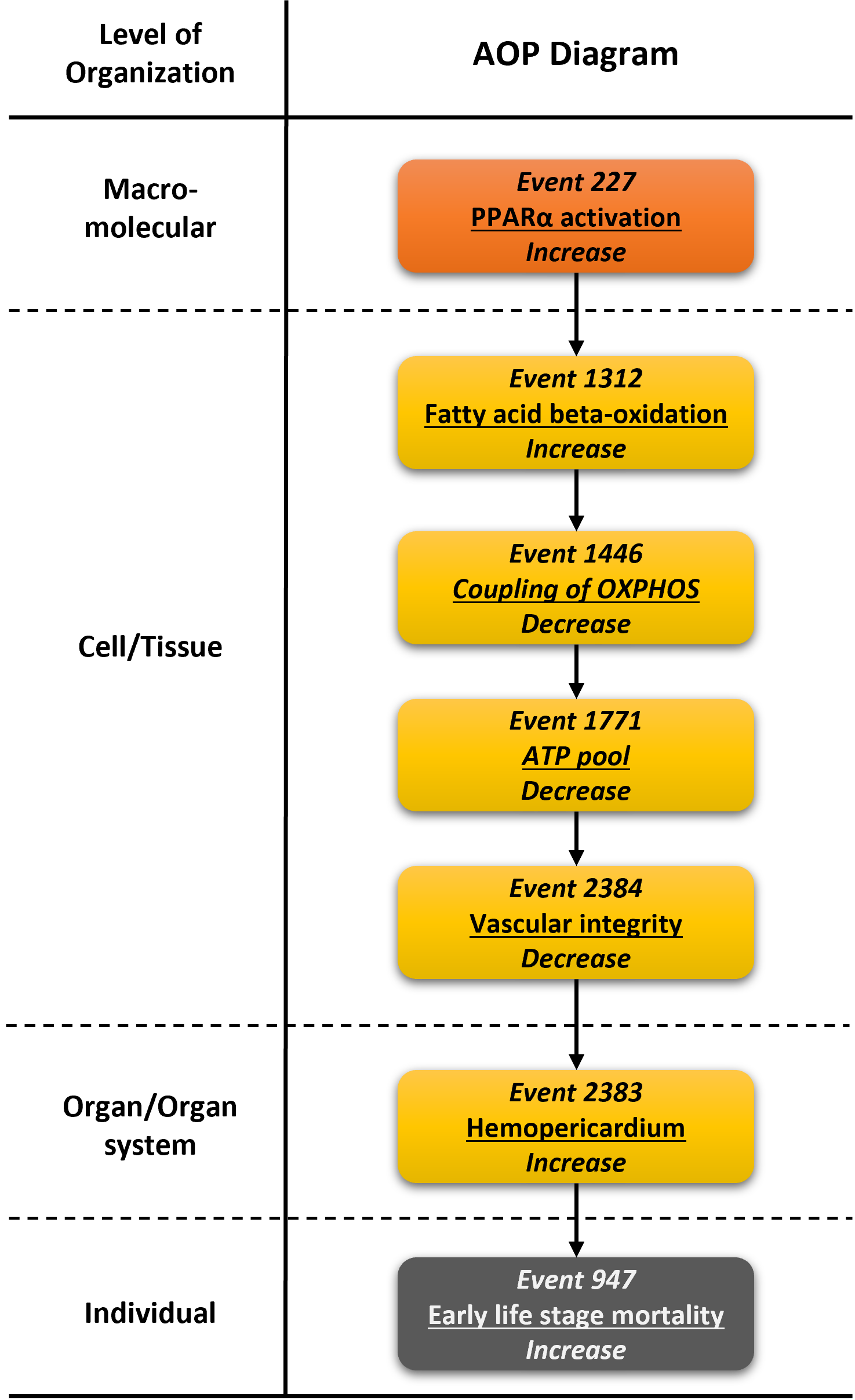
Graphical Representation
Additional AOP Exploration Options
Click links below to explore AOP 612, Peroxisome proliferator-activated receptor alpha activation leading to early life stage mortality via reduced adenosine triphosphate in tools offered by third parties.

Point of Contact
Contributors
- You Song
Coaches
OECD Information Table
| OECD Project # | OECD Status | Reviewer's Reports | Journal-format Article | OECD iLibrary Published Version |
|---|---|---|---|---|
This AOP was last modified on November 07, 2025 05:15
Revision dates for related pages
| Page | Revision Date/Time |
|---|---|
| Activation, PPARα | December 28, 2020 12:48 |
| Increase, Fatty acid beta-oxidation | December 04, 2020 15:21 |
| Decrease, Coupling of oxidative phosphorylation | November 07, 2025 05:15 |
| Decrease, Adenosine triphosphate pool | June 14, 2021 13:40 |
| Decrease, Vascular integrity | November 07, 2025 05:42 |
| Increase, Hemopericardium | October 29, 2025 17:05 |
| Increase, Early Life Stage Mortality | March 22, 2018 10:23 |
| Activation, PPARα leads to Increase, Fatty acid β-oxidation | October 30, 2025 04:18 |
| Increase, Fatty acid β-oxidation leads to Decrease, Coupling of OXPHOS | October 30, 2025 04:18 |
| Decrease, Coupling of OXPHOS leads to Decrease, ATP pool | October 06, 2026 06:40 |
| Decrease, ATP pool leads to Decrease, Vascular integrity | October 30, 2025 04:19 |
| Decrease, Vascular integrity leads to Increase, Hemopericardium | October 30, 2025 04:19 |
| Increase, Hemopericardium leads to Increase, Early Life Stage Mortality | October 30, 2025 04:19 |
Abstract
This Adverse Outcome Pathway (AOP) describes the mechanistic linkage between activation of peroxisome proliferator-activated receptor alpha (PPARα) and increased mortality during early developmental stages in fish. The molecular initiating event (MIE) involves chemical activation of PPARα, leading to enhanced fatty acid β-oxidation, disrupted oxidative phosphorylation (OXPHOS) coupling, ATP depletion, loss of vascular integrity, hemopericardium, and ultimately early life stage mortality. This AOP integrates molecular, biochemical, and apical endpoints relevant to energy metabolism and cardiovascular development. It provides a mechanistically coherent framework for understanding developmental toxicity of peroxisome proliferators, including certain per- and polyfluoroalkyl substances (PFAS), and supports application of new approach methodologies (NAMs) and read-across strategies in ecological risk assessment.
AOP Development Strategy
Context
This AOP was developed to capture the conserved mitochondrial and metabolic perturbations following PPARα activation observed in multiple species. Peroxisome proliferators, including PFAS and phthalates, activate PPARα and induce transcriptional programs that increase β-oxidation of fatty acids. Excessive β-oxidation perturbs mitochondrial homeostasis, resulting in oxidative stress, ATP depletion, and vascular defects. These mechanisms are consistent with observed early life stage lethality in zebrafish and other fish models exposed to PPARα agonists. The AOP contributes to the expanding network of metabolism-centered AOPs and provides biological context for developmental toxicity mechanisms without relying on animal testing.
Strategy
Data were identified through systematic searches of PubMed, AOP-Wiki, and OECD databases (2010–2025) using combinations of the following keywords: PPARα, fatty acid oxidation, oxidative phosphorylation, ATP depletion, vascular integrity, hemopericardium, developmental toxicity, zebrafish, PFAS, phthalate, peroxisome proliferator. Inclusion criteria required mechanistic or quantitative evidence linking key events (KEs) in vertebrate embryos or early juvenile stages. Empirical data from in vitro bioassays, zebrafish embryos, and rodent models were considered. The weight of evidence was evaluated using the OECD principles of AOP development—biological plausibility, essentiality, and empirical support.
Summary of the AOP
Events:
Molecular Initiating Events (MIE)
Key Events (KE)
Adverse Outcomes (AO)
| Type | Event ID | Title | Short name |
|---|
| MIE | 227 | Activation, PPARα | Activation, PPARα |
| KE | 1312 | Increase, Fatty acid beta-oxidation | Increase, Fatty acid β-oxidation |
| KE | 1446 | Decrease, Coupling of oxidative phosphorylation | Decrease, Coupling of OXPHOS |
| KE | 1771 | Decrease, Adenosine triphosphate pool | Decrease, ATP pool |
| KE | 2384 | Decrease, Vascular integrity | Decrease, Vascular integrity |
| KE | 2383 | Increase, Hemopericardium | Increase, Hemopericardium |
| AO | 947 | Increase, Early Life Stage Mortality | Increase, Early Life Stage Mortality |
Relationships Between Two Key Events (Including MIEs and AOs)
| Title | Adjacency | Evidence | Quantitative Understanding |
|---|
Network View
Prototypical Stressors
Life Stage Applicability
| Life stage | Evidence |
|---|---|
| Embryo | |
| Juvenile |
Taxonomic Applicability
| Term | Scientific Term | Evidence | Link |
|---|---|---|---|
| zebrafish | Danio rerio | NCBI |
Sex Applicability
| Sex | Evidence |
|---|---|
| Unspecific |
Overall Assessment of the AOP
This AOP is biologically coherent and supported by moderate-to-strong empirical data across molecular and organismal levels. The essentiality of upstream events (PPARα activation and increased β-oxidation) is well supported by experimental data using PPARα knockouts and pharmacological antagonists. Downstream events, such as decreased ATP levels, compromised vascular integrity, and hemopericardium, have been observed across diverse PPARα activators in fish embryos, indicating reproducibility. However, quantitative relationships between intermediate KEs and mortality remain incompletely defined. The AOP has moderate confidence overall and is applicable for screening-level hazard identification, read-across, and developmental toxicity prioritization.
Domain of Applicability
-
Taxa: Primarily teleost fish (e.g., Danio rerio, Oryzias latipes); mechanistic plausibility extends to other vertebrates.
-
Life stage: Embryonic and early larval development.
-
Sex: Not sex-specific at early life stages.
-
Biological systems: Liver, muscle, and cardiovascular systems.
Essentiality of the Key Events
| Key Event | Essentiality Evidence | Type of Evidence |
|---|---|---|
| PPARα activation (MIE) | Knockdown or knockout of ppara in zebrafish prevents β-oxidation induction and metabolic effects following exposure to PPARα agonists. | Direct |
| Increased fatty acid β-oxidation | Chemical inhibitors (e.g., etomoxir) of β-oxidation prevent ATP depletion and vascular effects. | Direct |
| Decreased coupling of OXPHOS | Reduced mitochondrial efficiency and ROS generation precede ATP loss and morphological abnormalities. | Indirect |
| Decreased ATP pool | ATP supplementation or metabolic rescue mitigates vascular and cardiac defects. | Direct |
| Decreased vascular integrity | Vascular permeability assays correlate strongly with cardiac edema and mortality outcomes. | Indirect |
| Increased hemopericardium | Observed consistently in PPARα agonist-exposed embryos; severity predicts mortality. | Indirect |
| Increased early life stage mortality (AO) | Apical endpoint following cumulative mitochondrial and vascular dysfunction. | Outcome |
Evidence Assessment
Biological Plausibility
High. The pathway aligns with well-characterized PPARα-mediated transcriptional regulation of energy metabolism. Excessive β-oxidation generates ROS and perturbs mitochondrial homeostasis, leading to ATP depletion and vascular collapse, consistent with observed early life stage mortality.
Empirical Support
Moderate. Numerous studies report coherent concentration–response relationships between upstream and downstream KEs. Zebrafish embryos exposed to PFAS (e.g., HFPO-DA, PFOA) or fibrates (e.g., clofibrate) exhibit transcriptional activation of ppara target genes, mitochondrial dysfunction, hemopericardium, and mortality.
Quantitative Understanding
Low to moderate. While dose–response data exist for individual KEs, quantitative linkage functions (KERs) are not yet formalized. The AOP can be qualitatively modeled but lacks a complete mathematical framework.
Known Modulating Factors
| Modulating Factor (MF) | Influence or Outcome | KER(s) Involved |
|---|---|---|
| Energy/nutrient availability | Limited glucose or lipid substrates reduce β-oxidation flux and lower ATP depletion severity; conversely, high lipid load enhances PPARα activation and downstream metabolic disruption. | PPARα activation (increase) → Fatty acid β-oxidation (increase); β-oxidation (increase) → Coupling of OXPHOS (decrease) |
| Antioxidant capacity | Elevated antioxidant defenses (e.g., glutathione, SOD, catalase) buffer ROS generated by excessive β-oxidation and OXPHOS uncoupling, mitigating ATP loss and vascular effects. | Coupling of OXPHOS (decrease) → ATP pool (decrease); ATP pool (decrease) → Vascular integrity (decrease) |
| Oxygen availability | Hypoxia limits oxidative metabolism, reducing ROS formation and ATP depletion; hyperoxia or increased oxygen tension enhances oxidative damage and mitochondrial uncoupling. | Coupling of OXPHOS (decrease) → ATP pool (decrease) |
| Temperature | Elevated temperature accelerates mitochondrial respiration and energy turnover, intensifying ATP depletion and vascular damage. | β-oxidation (increase) → OXPHOS coupling (decrease); ATP pool (decrease) → Vascular integrity (decrease) |
| Developmental stage | Early embryos are more vulnerable due to higher energy demand and immature mitochondrial and antioxidant systems. | ATP pool (decrease) → Vascular integrity (decrease); Vascular integrity (decrease) → Hemopericardium (increase) |
| Mitochondrial density and efficiency | Tissues with high mitochondrial density (heart, liver, muscle) show more pronounced energy depletion and structural defects. | OXPHOS coupling (decrease) → ATP pool (decrease); ATP pool (decrease) → Vascular integrity (decrease) |
| Chemical lipophilicity | Lipophilic compounds bioaccumulate in lipid-rich embryonic ti |
Quantitative Understanding
Limited quantitative KERs available. Correlative evidence suggests that ≥40–50% reduction in ATP levels is associated with severe vascular leakage and increased mortality probability.
Considerations for Potential Applications of the AOP (optional)
-
Supports read-across of PPARα-activating chemicals (e.g., PFAS, fibrates, phthalates).
-
Enables in vitro-to-in vivo extrapolation through metabolic biomarkers (e.g., β-oxidation gene expression, ATP depletion).
-
Applicable to screening-level developmental toxicity assessments in non-animal frameworks (e.g., NGRA, IATA).
-
May inform adverse outcome network linkages with hepatic steatosis and mitochondrial dysfunction AOPs.