
This AOP is licensed under the BY-SA license. This license allows reusers to distribute, remix, adapt, and build upon the material in any medium or format, so long as attribution is given to the creator. The license allows for commercial use. If you remix, adapt, or build upon the material, you must license the modified material under identical terms.
AOP: 651
Title
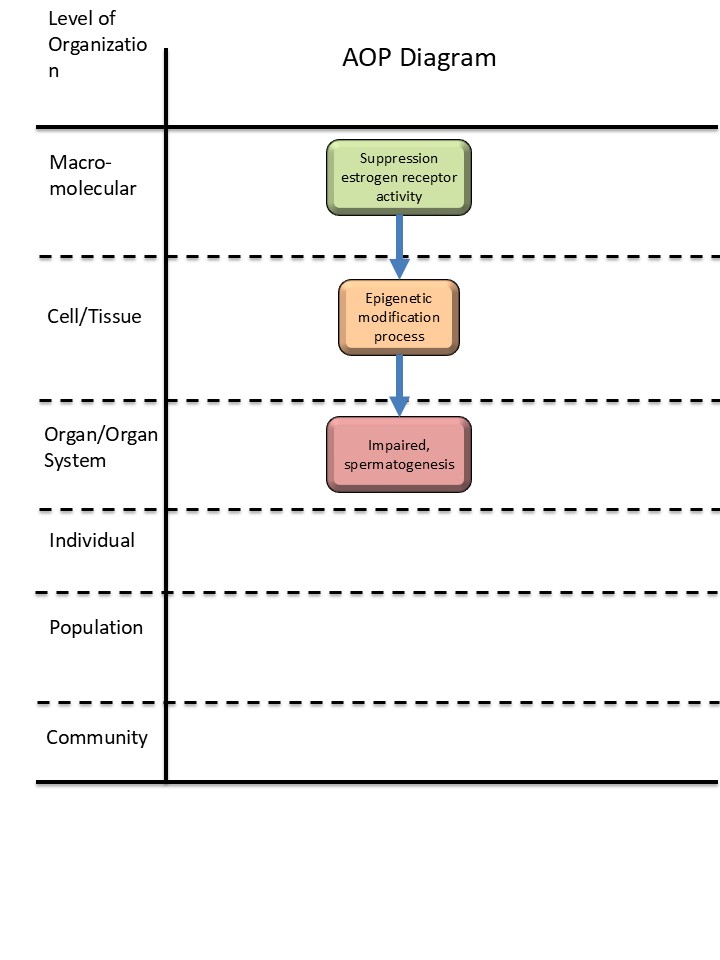
Suppression, Estrogen receptor (ER) activity leads to Impaired, Spermatogenesis via epigenetic modifications
Short name
Graphical Representation
Additional AOP Exploration Options
Click links below to explore AOP 651, Suppression, Estrogen receptor (ER) activity leads to Impaired, Spermatogenesis via epigenetic modifications in tools offered by third parties.

Point of Contact
Contributors
- John Frisch
Coaches
OECD Information Table
| OECD Project # | OECD Status | Reviewer's Reports | Journal-format Article | OECD iLibrary Published Version |
|---|---|---|---|---|
This AOP was last modified on July 28, 2026 11:22
Revision dates for related pages
| Page | Revision Date/Time |
|---|---|
| Suppression, Estrogen receptor (ER) activity | July 28, 2026 10:42 |
| Epigenetic modification process | July 28, 2026 10:49 |
| Impaired, Spermatogenesis | July 28, 2026 10:54 |
| Suppression, Estrogen receptor (ER) activity leads to Epigenetic modification process | July 28, 2026 11:13 |
| Epigenetic modification process leads to Impaired, Spermatogenesis | July 28, 2026 11:18 |
Abstract
Estrogen receptors (ER) are nuclear transcription factors involved in regulation of many physiological processes in vertebrates through signalling. There are two main classic types of nuclear estrogen receptors, estrogen receptor alpha (ERα) and estrogen receptor beta (ERβ) receptors and a more recently discovered membrane receptor, G protein-coupled estrogen receptor 1 (GPER1; Chen et al. (2022)). Binding by estrogen activates estrogen receptor activity. Suppression of estrogen receptor activity occurs when a stressor hinders estrogen binding to estrogen receptors or when estrogen levels are diminished, resulting in lowered estrogen receptor activity.
Epigenetic modifications are alterations that affect gene expression without altering the underlying gene sequence. Among some of the more common processes that lead to epigenetic modifications are DNA methylation and alteration of histone proteins. DNA methylation involves addition of methyl groups to DNA which causes increased or decreased gene expression. Histone proteins are small proteins that assist gene expression, DNA repair, and DNA replication; histones can be modified by the addition of methyl, acetyl, or phosphate groups, which accelerates or slows DNA expression, repair, and replication.
Spermatogenesis is the process in which germ cells develop into mature sperm in testes in male animals. Impaired spermatogenesis can result in lower mature sperm counts, problems in proper sperm function such as sperm motility, or other sperm abnormalities. For review of normal epigenetic modifications in spermatogenesis, see Gunes and Kulac (2013), for review of how disruption of epigenetic modifications disrupts spermatogenesis, see Cui et al. (2025).
This AOP contributes to the scientific understanding of the mechanistic foundations for linking suppression of estrogen receptor activity to the adverse outcome impaired spermatogenesis, with sperm motility, morphology, and abnormalities representing apical endpoints in guideline tests associated with the Endocrine Disruptor Screening Program (US EPA 1998; OECD 2001).
AOP Development Strategy
Context
This AOP was part of an Environmental Protection Agency effort to develop AOPs that establish scientifically supported causal linkages between alternative endpoints measured using new approach methodologies (NAMs) and guideline apical endpoints measured in Tier 1 and Tier 2 test guidelines (U.S. EPA, 2025) employed by the Endocrine Disruptor Screening Program (EDSP). A series of key events that represent significant, measurable, milestones connecting molecular initiation to apical endpoints indicative of adversity were identified based on scientific review articles and empirical studies. Additionally, scientific evidence supporting the causal relationships between each pair of key events was assembled and evaluated. The present effort focused primarily on empirical studies with laboratory mammals.
Strategy
The scope of the aforementioned EPA project was to develop AOP(s) relevant to apical endpoints employed in the test guidelines, based on mechanisms consistent with empirical studies. The literature used to support this AOP and its constituent pages began with the test guidelines and followed to primary, secondary, and/or tertiary works concerning the relevant underlying biology. KE and KER page creation and re-use was determined using Handbook principles where page re-use was preferred.

Summary of the AOP
Events:
Molecular Initiating Events (MIE)
Key Events (KE)
Adverse Outcomes (AO)
| Type | Event ID | Title | Short name |
|---|
| MIE | 1046 | Suppression, Estrogen receptor (ER) activity | Suppression, Estrogen receptor (ER) activity |
| KE | 2152 | Epigenetic modification process | Epigenetic modification process |
| AO | 1758 | Impaired, Spermatogenesis | Impaired, Spermatogenesis |
Relationships Between Two Key Events (Including MIEs and AOs)
| Title | Adjacency | Evidence | Quantitative Understanding |
|---|
| Suppression, Estrogen receptor (ER) activity leads to Epigenetic modification process | adjacent | Moderate | |
| Epigenetic modification process leads to Impaired, Spermatogenesis | adjacent | Moderate |
Network View
Prototypical Stressors
Life Stage Applicability
| Life stage | Evidence |
|---|---|
| Adult, reproductively mature | Moderate |
Taxonomic Applicability
Sex Applicability
| Sex | Evidence |
|---|---|
| Male | High |
Overall Assessment of the AOP
|
1. Support for Biological Plausibility of Key Event Relationships: Is there a mechanistic relationship between KEup and KEdown consistent with established biological knowledge? |
|
|
Key Event Relationship (KER) |
Level of Support Strong = Extensive understanding of the KER based on extensive previous documentation and broad acceptance. Moderate = Support of essentiality from empirical studies, with some uncertainty in how tightly upstream events are linked to downstream events. |
|
Relationship 3833: Suppression, Estrogen receptor (ER) activity leads to epigenetic modifications |
Moderate support. The relationship between suppression of estrogen receptor activity and epigenetic modifications is broadly accepted and supported by animal data, particularly laboratory mammal data. Given the complexity of molecular-level interactions, it is difficult to link suppression of ER signalling to specific epigenetic modifications. |
|
Relationship 3834: Epigenetic modifications leads to impaired, Spermatogenesis |
Moderate support. The relationship between epigenetic modifications and impaired spermatogenesis is broadly accepted and supported by animal data, particularly laboratory mammal data. Although specific epigenetic modifications have been linked to specific spermatogenesis impairments, it is difficult to establish causality. |
|
Overall |
Moderate support. Extensive understanding of the relationships between events from empirical studies from animals, particularly laboratory mammals. |
Domain of Applicability
Life Stage: Adult, reproductively mature for process producing fully functional sperm.
Sex: Applies to males as related to sperm.
Taxonomic: Largely studied in laboratory mammals, plausible for all vertebrates as estrogen receptors have been evolutionarily conserved.
Essentiality of the Key Events
|
2. Essentiality of Key Events: Are downstream KEs and/or the AO prevented if an upstream KE is blocked? |
|
|
Key Event (KE) |
Level of Support Strong = Direct evidence from specifically designed experimental studies illustrating essentiality and direct relationship between key events. |
|
MIE 1046 Suppression, Estrogen receptor (ER) activity |
Strong support. Suppression of estrogen receptor activity leads to epigenetic modifications. Evidence is available from exposure to endocrine-disrupting compounds and toxicants. Best evidence for essentiality for estrogen receptor activity is from stressor exposure studies decreasing estrogen receptor activity leading to altered histone messenger RNA, protein and methylation. |
|
KE 2152 Epigenetic modifications |
Strong support. Epigenetic modifications lead to impaired spermatogenesis. Evidence is available from exposure to endocrine-disrupting compounds and toxicants. Best evidence for essentiality of epigenetic modifications is from studies showing a specific epigenetic modification leading to a specific impairment of spermatogenesis (reviewed by Cui et al. 2025). |
|
AO 1758 Impaired, Spermatogenesis |
This is the final event of the AOP. |
|
Overall |
Strong support. Direct evidence from empirical studies from animals, particularly laboratory mammals for all key events. |
Evidence Assessment
|
3. Empirical Support for Key Event Relationship: Does empirical evidence support that a change in KEup leads to an appropriate change in KEdown? |
|
|
Key Event Relationship (KER) |
Level of Support Strong = Experimental evidence from exposure to toxicant shows consistent change in both events across taxa and study conditions. |
|
Relationship 3833: Suppression, Estrogen receptor (ER) activity leads to epigenetic modifications |
Strong support. Suppression of estrogen receptor activity leads to epigenetic modifications. Evidence is available from endocrine disruptor and toxicant studies. Suppression of estrogen receptor activity occurred earlier in the time-course of exposure than epigenetic modifications, and the concentrations of stressors that suppressed estrogen receptor activity were equal to or lower than the concentrations that led to epigenetic modifications. Therefore, the data support a causal relationship. |
|
Relationship 3834: Epigenetic modifications leads to impaired, Spermatogenesis |
Strong support. Epigenetic modifications leads to impaired spermatogenesis. Evidence is available from endocrine disruptor and toxicant studies. Epigenetic modifications occurred earlier in the time-course of exposure than impaired spermatogenesis, and the concentrations of stressors that caused epigenetic modifications were equal to or lower than the concentrations that led to impaired spermatogenesis. Therefore, the data support a causal relationship. |
|
Overall |
Strong support. Evidence from empirical studies shows consistent relationships in upstream and downstream events, with upstream events occurring earlier in the time-course of exposure and at equal or lower concentrations than downstream events, supporting causal relationships. |
Known Modulating Factors
| Modulating Factor (MF) | Influence or Outcome | KER(s) involved |
|---|---|---|
Quantitative Understanding
Considerations for Potential Applications of the AOP (optional)
References
Chen P, Li B, Ou-Yang L. 2022. Role of estrogen receptors in health and disease. Frontiers in Endrocrinology 13:839005.
Cui Y, Deng J, Zhang Y, Du L, Jiang F, Li C, Chen W, Zhang H, He Z. 2025. Epigenetic regulation by DNA methylation, histone modifications and chromatin remodeling complexes in controlling spermatogenesis and their dysfunction with male infertility. Cellular and Molecular Life Sciences 82(1): 343.
Gunes S, Kulac T. 2013. The role of epigenetics in spermatogenesis. Turkish Journal of Urology 39(3): 181-187.
Organisation for Economic Co-operation and Development. 2001. Test No. 416: Two-Generation Reproduction Toxicity, OECD Guidelines for the Testing of Chemicals, Section 4. https://www.oecd.org/content/dam/oecd/en/publications/reports/2001/01/test-no-416-two-generation-reproduction-toxicity_g1gh2941/9789264070868-en.pdf (retrieved 15 July 2026)
U.S. Environmental Protection Agency. 1998. Health Effects Test Guidelines OPPTS 870.3800 Reproduction and Fertility Effects. https://ntp.niehs.nih.gov/sites/default/files/iccvam/suppdocs/feddocs/epa/epa_870_3800.pdf (retrieved 24 December 2025)
U.S. Environmental Protection Agency. 2025. EDSP Test Guidelines and Guidance Document. https://www.epa.gov/test-guidelines-pesticides-and-toxic-substances/edsp-test-guidelines-and-guidance-document (retrieved 25 July 2025).