
The authors have designated this AOP as all rights reserved. Re-use in any form requires advanced permission from the authors.
AOP: 636
Title
Increase in reactive oxygen species (ROS) leading to human amyotrophic lateral sclerosis (ALS)
Short name
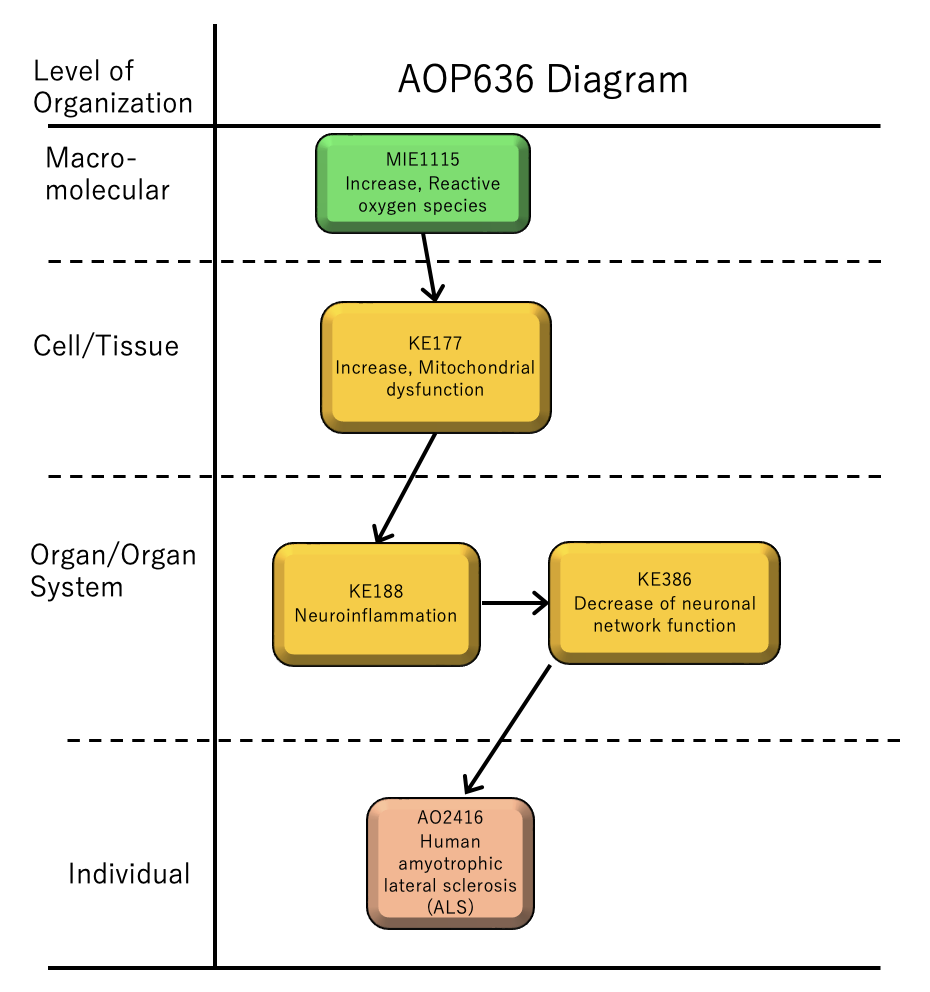
Graphical Representation
Additional AOP Exploration Options
Click links below to explore AOP 636, Increase in reactive oxygen species (ROS) leading to human amyotrophic lateral sclerosis (ALS) in tools offered by third parties.

Point of Contact
Contributors
- Shihori Tanabe
Coaches
- You Song
OECD Information Table
| OECD Project # | OECD Status | Reviewer's Reports | Journal-format Article | OECD iLibrary Published Version |
|---|---|---|---|---|
This AOP was last modified on September 17, 2026 03:39
Revision dates for related pages
| Page | Revision Date/Time |
|---|---|
| Increase, Reactive oxygen species | June 12, 2025 01:27 |
| Increase, Mitochondrial dysfunction | February 11, 2026 07:06 |
| Neuroinflammation | July 15, 2022 09:54 |
| Decrease of neuronal network function | May 28, 2018 11:36 |
| human amyotrophic lateral sclerosis (ALS) | August 20, 2026 21:22 |
| Increase, TDP-43 aggregation | September 06, 2026 20:36 |
| Increase, Oxidative Stress | September 02, 2026 04:19 |
| Increase, ROS leads to Increase, Oxidative Stress | June 23, 2026 06:57 |
| Increase, Oxidative Stress leads to TDP-43 aggregation | September 17, 2026 03:38 |
| TDP-43 aggregation leads to Increase, Mitochondrial dysfunction | September 17, 2026 03:38 |
| Increase, Mitochondrial dysfunction leads to Neuroinflammation | April 02, 2026 01:40 |
| Neuroinflammation leads to Neuronal network function, Decreased | October 26, 2021 03:50 |
| Neuronal network function, Decreased leads to ALS | April 02, 2026 01:41 |
| Increase, ROS leads to Increase, Mitochondrial dysfunction | February 25, 2025 14:26 |
| Reactive oxygen species | August 15, 2017 10:43 |
Abstract
Amyotrophic lateral sclerosis (ALS) is a fatal neurodegenerative disease characterized by the impairment of motor neurons in the brain and spinal cord, leading to skeletal muscle atrophy and eventual death due to respiratory muscle paralysis. Currently, fundamental curative treatments remain unestablished. The objective of this study is to develop an Adverse Outcome Pathway (AOP) for ALS to elucidate its underlying pathological mechanisms. By analyzing molecular networks using RNA-seq data and synthesizing existing literature, we have proposed a draft AOP. This pathway delineates the progression from an initial rise in reactive oxygen species (ROS) and oxidative stress to neurodegeneration and motor neuron death, mediated by key events such as TDP-43 aggregation, mitochondrial dysfunction, neuroinflammation, and axonal transport failure. In developing a quantitative AOP (qAOP), it is essential to assess the quantifiability of each Key Event (KE) and Key Event Relationship (KER) to accurately model the network's functional relationships. Current AOP636 starts with MIE1115, an increase in ROS, links to KE177, an increase in mitochondrial dysfunction, KE188, neuroinflammation, and KE386, a decrease in neuronal network function, and leads to AO2416 human ALS. We need to develop a new KE2416 on ALS and KERs with a quantitative understanding.
AOP Development Strategy
Context
Strategy
Summary of the AOP
Events:
Molecular Initiating Events (MIE)
Key Events (KE)
Adverse Outcomes (AO)
| Type | Event ID | Title | Short name |
|---|
| MIE | 1115 | Increase, Reactive oxygen species | Increase, ROS |
| KE | 1392 | Increase, Oxidative Stress | Increase, Oxidative Stress |
| KE | 2451 | Increase, TDP-43 aggregation | TDP-43 aggregation |
| KE | 177 | Increase, Mitochondrial dysfunction | Increase, Mitochondrial dysfunction |
| KE | 188 | Neuroinflammation | Neuroinflammation |
| KE | 386 | Decrease of neuronal network function | Neuronal network function, Decreased |
| AO | 2416 | human amyotrophic lateral sclerosis (ALS) | ALS |
Relationships Between Two Key Events (Including MIEs and AOs)
| Title | Adjacency | Evidence | Quantitative Understanding |
|---|
| Increase, ROS leads to Increase, Oxidative Stress | adjacent | High | |
| Increase, Oxidative Stress leads to TDP-43 aggregation | adjacent | Moderate | |
| TDP-43 aggregation leads to Increase, Mitochondrial dysfunction | adjacent | Moderate | |
| Increase, Mitochondrial dysfunction leads to Neuroinflammation | adjacent | High | |
| Neuroinflammation leads to Neuronal network function, Decreased | adjacent | High | |
| Neuronal network function, Decreased leads to ALS | adjacent | High | |
| Increase, ROS leads to Increase, Mitochondrial dysfunction | adjacent | High |
Network View
Prototypical Stressors
Life Stage Applicability
| Life stage | Evidence |
|---|---|
| Adult | High |
Taxonomic Applicability
| Term | Scientific Term | Evidence | Link |
|---|---|---|---|
| Homo sapiens | Homo sapiens | High | NCBI |
Sex Applicability
| Sex | Evidence |
|---|---|
| Male | High |
| Female | High |
Overall Assessment of the AOP
Domain of Applicability
Essentiality of the Key Events
Evidence Assessment
Known Modulating Factors
| Modulating Factor (MF) | Influence or Outcome | KER(s) involved |
|---|---|---|