
The authors have designated this AOP as all rights reserved. Re-use in any form requires advanced permission from the authors.
AOP: 660
Title
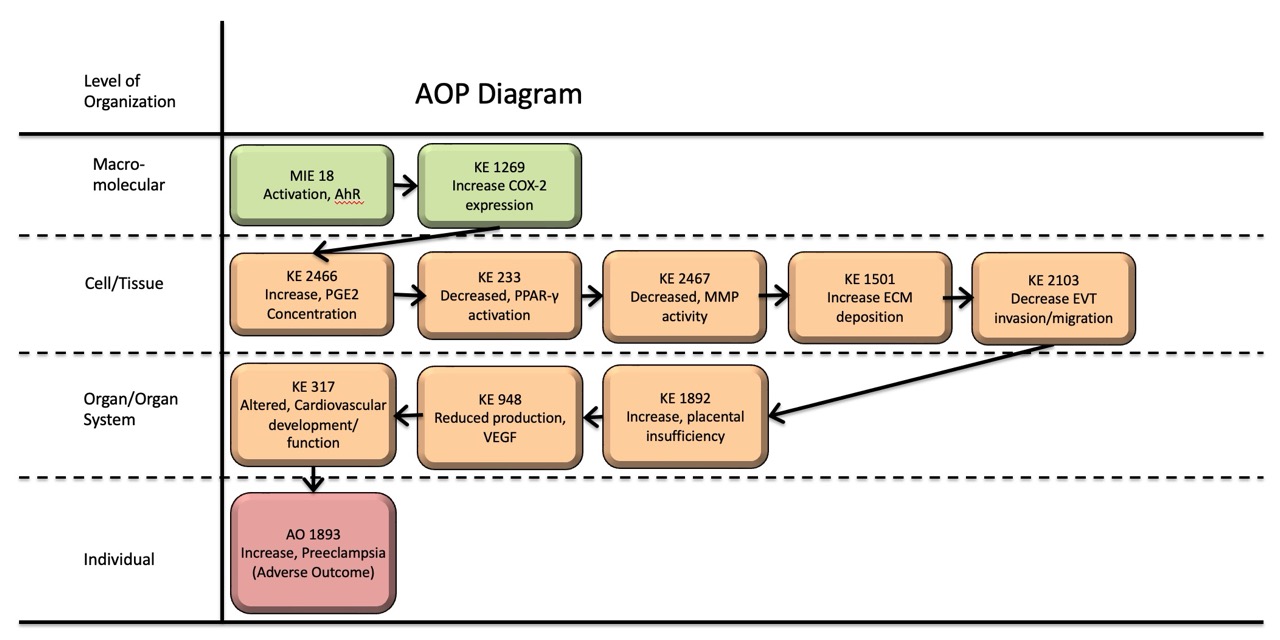
Activation of aryl hydrocarbon receptor (AhR) leading to preeclampsia via COX-2/PPAR-gamma-mediated trophoblast dysfunction
Short name
Graphical Representation
Additional AOP Exploration Options
Click links below to explore AOP 660, Activation of aryl hydrocarbon receptor (AhR) leading to preeclampsia via COX-2/PPAR-gamma-mediated trophoblast dysfunction in tools offered by third parties.

Point of Contact
Contributors
- YuCheng Nien
Coaches
OECD Information Table
| OECD Project # | OECD Status | Reviewer's Reports | Journal-format Article | OECD iLibrary Published Version |
|---|---|---|---|---|
This AOP was last modified on November 17, 2026 19:51
Revision dates for related pages
| Page | Revision Date/Time |
|---|---|
| Activation, AhR | May 31, 2025 07:56 |
| increase, Preeclampsia | May 31, 2021 10:58 |
| Increase, COX-2 expression | March 20, 2018 16:33 |
| reduced production, VEGF | March 28, 2018 11:48 |
| Altered, Cardiovascular development/function | September 16, 2017 10:14 |
| Decreased trophoblast invasion/migration | November 17, 2026 01:45 |
| Increase, Prostaglandin E2 concentration | November 17, 2026 01:44 |
| Decreased, PPAR-gamma activation | October 30, 2023 09:07 |
| Increase, Extracellular matrix deposition | February 10, 2026 04:44 |
| Decreased, MMP | November 17, 2026 01:23 |
| increase, placental insufficiency | May 31, 2021 10:54 |
| Activation, AhR leads to Increase, COX-2 expression | November 17, 2026 01:34 |
| Increase, COX-2 expression leads to Increase, Prostaglandin E2 concentration | November 17, 2026 01:26 |
| Increase, COX-2 expression leads to Altered, Cardiovascular development/function | March 28, 2018 13:24 |
| Increase, Prostaglandin E2 concentration leads to Decreased, PPAR-gamma activation | November 17, 2026 02:03 |
| Decreased, PPAR-gamma activation leads to Decreased, MMP | November 17, 2026 01:31 |
| Decreased, MMP leads to Increase, ECM deposition | November 17, 2026 01:32 |
| Increase, ECM deposition leads to Cellular dysfunction (human placenta trophoblast cells) | November 17, 2026 01:32 |
| Cellular dysfunction (human placenta trophoblast cells) leads to increase, placental insufficiency | November 17, 2026 01:57 |
| increase, placental insufficiency leads to reduced production, VEGF | November 17, 2026 02:00 |
| reduced production, VEGF leads to Altered, Cardiovascular development/function | November 17, 2026 02:04 |
| reduced production, VEGF leads to increase, Preeclampsia | November 17, 2026 01:37 |
| Altered, Cardiovascular development/function leads to increase, Preeclampsia | November 17, 2026 01:33 |
| N(6)-Carboxymethyllysine | November 16, 2026 21:51 |
| Selected AHR Ligands | November 29, 2016 21:20 |
Abstract
Preeclampsia (PE) is a severe pregnancy-specific hypertensive disorder affecting 3-5% of pregnancies globally and is a leading cause of maternal and perinatal morbidity and mortality, with significantly elevated risk and clinical severity among women with diabetes. This Adverse Outcome Pathway (AOP) was initiated to elucidate the mechanistic linkage between diabetic hyperglycemia and exacerbated PE pathology via the aryl hydrocarbon receptor (AhR) signaling axis. Under hyperglycemic conditions, non-enzymatic glycoxidation and lipid peroxidation promote the accumulation of N-ε-carboxymethyllysine (CML), which acts as a stressor to trigger the Molecular Initiating Event (MIE): Activation, AhR (Event 18) in placental trophoblasts and endothelial cells. Aberrant AhR activation subsequently induces Increase, COX-2 expression (Event 1269) and Increase, Prostaglandin E2 concentration (Event 2466). Excessive PGE2 signaling leads to Decreased, PPAR-gamma activation (Event 233), which in turn drives Decreased, MMP (Event 2467) activity and Increase, Extracellular matrix deposition (Event 1501) within the placental microenvironment. Together, matrix remodeling arrest and excessive ECM accumulation result in Decreased trophoblast invasion/migration (Event 2103), impairing uterine spiral artery remodeling and leading to placental insufficiency (Event 1892) and hypoxia. Placental ischemia subsequently triggers the release of anti-angiogenic factors, resulting in reduced production, VEGF (Event 948) and Altered, Cardiovascular development/function (Event 317)—manifesting as widespread maternal vascular endothelial dysfunction and vasoconstriction—which ultimately culminate in the Adverse Outcome (AO) of increase, Preeclampsia (Event 1893). Overall, the biological plausibility of this pathway is supported by moderate-to-strong empirical evidence from diabetic vascular/renal models demonstrating CML–AhR–COX-2/PGE2 signaling, alongside established roles of PPAR-γ, MMPs, and VEGF in placentation. However, major knowledge gaps remain regarding quantitative CML thresholds in early human gestation and direct causal confirmation of the AhR–COX-2/PGE2–PPAR-γ cascade at the human maternal-fetal interface. Scientifically and regulatorily, this AOP provides an organizing framework for identifying early predictive biomarkers, evaluating developmental and reproductive toxicity (DART) of AhR ligands, and guiding targeted preventive interventions for high-risk diabetic pregnancies.
AOP Development Strategy
Context
Pregnant women with preexisting diabetes or gestational diabetes mellitus face a substantially elevated risk of developing severe PE and preterm birth. This Adverse Outcome Pathway (AOP) was developed to address a critical mechanistic question: How does a diabetic hyperglycemic microenvironment disrupt trophoblast invasion, angiogenic balance, and uterine spiral artery remodeling, thereby exacerbating the clinical severity of preeclampsia?
The primary objectives of developing this AOP are to 1. Document specialized placental and vascular biology: Synthesize cross-disciplinary evidence connecting diabetic nephropathic/vascular mechanisms (CML–AhR–COX-2/PGE2 signaling) with PPAR-γ downregulation, MMP suppression, extracellular matrix (ECM) remodeling, and placental angiogenesis (VEGF). 2. Establish the biological relevance of upstream molecular and cellular assays (e.g., serum CML-modified peptides, AhR activation, COX-2/PGE2 levels, PPAR-γ activity, MMP-2/MMP-9 expression, and VEGF production) alongside clinical angiogenic biomarkers (sFlt-1/PlGF ratio) to guide early risk stratification and targeted therapeutic interventions for high-risk diabetic pregnancies.
Strategy
This Adverse Outcome Pathway (AOP) was developed using a cross-disease translational strategy, bridging well-characterized clinical pathology at the Adverse Outcome (AO) end with mechanistic molecular toxicology at the Molecular Initiating Event (MIE) end:
- Cross-Organ Mechanistic Extrapolation (Diabetic Nephropathy to Placenta): To explain the high clinical incidence and severity of PE in pregnancies complicated by diabetes mellitus or gestational diabetes mellitus (GDM), we extrapolated a validated diabetic vascular/renal mechanism (Lee et al., 2016), in which hyperglycemia-derived N-ε-carboxymethyllysine (CML) activates AhR (Event 18) to upregulate COX-2 (Event 1269) and PGE2 (Event 2466), driving extracellular matrix (ECM) deposition (Event 1501) and inflammatory cell infiltration.
- Placental Microenvironment Integration: We bridged the upstream inflammatory axis (Events 1269 and 2466) to downstream trophoblast and vascular dysfunction (Events 2103, 948, and 317) through PPAR-γ inactivation (Event 233) and MMP downregulation (Event 2467), integrating pregnancy-specific regulatory networks.
Summary of the AOP
Events:
Molecular Initiating Events (MIE)
Key Events (KE)
Adverse Outcomes (AO)
| Type | Event ID | Title | Short name |
|---|
| MIE | 18 | Activation, AhR | Activation, AhR |
| KE | 1269 | Increase, COX-2 expression | Increase, COX-2 expression |
| KE | 2466 | Increase, Prostaglandin E2 concentration | Increase, Prostaglandin E2 concentration |
| KE | 233 | Decreased, PPAR-gamma activation | Decreased, PPAR-gamma activation |
| KE | 2467 | Decreased, MMP | Decreased, MMP |
| KE | 1501 | Increase, Extracellular matrix deposition | Increase, ECM deposition |
| KE | 2103 | Decreased trophoblast invasion/migration | Cellular dysfunction (human placenta trophoblast cells) |
| KE | 1892 | increase, placental insufficiency | increase, placental insufficiency |
| KE | 948 | reduced production, VEGF | reduced production, VEGF |
| KE | 317 | Altered, Cardiovascular development/function | Altered, Cardiovascular development/function |
| AO | 1893 | increase, Preeclampsia | increase, Preeclampsia |
Relationships Between Two Key Events (Including MIEs and AOs)
| Title | Adjacency | Evidence | Quantitative Understanding |
|---|
Network View
Prototypical Stressors
Life Stage Applicability
| Life stage | Evidence |
|---|---|
| Pregnancy | Moderate |
Taxonomic Applicability
Sex Applicability
| Sex | Evidence |
|---|---|
| Female | Moderate |
Overall Assessment of the AOP
|
Support for Biological Plausibility of KERs |
|
|
MIE => KE1: Activation, AhR leads to Increase, COX-2 expression |
Biological Plausibility of the MIE => KE1 is high. Rationale: Ligand-bound aryl hydrocarbon receptor (AhR) undergoes conformational activation and translocates into the nucleus, where it heterodimerizes with the AhR nuclear translocator (ARNT). The resulting AhR/ARNT transcription factor complex specifically binds to xenobiotic response elements (XREs/DREs) located within the promoter region of the PTGS2 gene (encoding cyclooxygenase-2, COX-2). This genomic binding recruits transcriptional coactivators to directly drive COX-2 mRNA synthesis and protein expression. (Lee et al. (2016); Vogel et al. (2007)) |
|
KE1 => KE2: Increase, COX-2 expression leads to Increase, Prostaglandin E2 concentration |
Biological Plausibility of the KE1 => KE2 is high. Rationale: Cyclooxygenase-2 (COX-2) functions as the rate-limiting enzyme converting membrane arachidonic acid into prostaglandin H2 (PGH2). PGH2 is subsequently isomerized to prostaglandin E2 (PGE2) via terminal microsomal prostaglandin E synthase-1 (mPGES-1). Elevated COX-2 protein level directly leads to a stoichiometric increase in PGE2 synthesis and extracellular secretion. (Lee et al. (2016); Li et al. (2015)) |
|
KE2 => KE3: Increase, Prostaglandin E2 concentration leads to Decreased, PPAR-gamma activation |
Biological Plausibility of the KE2 => KE3 is high. Rationale: Extracellular PGE2 binds to G-protein coupled E-prostanoid receptors (EP2/EP4) on trophoblasts, activating intracellular cAMP/PKA and ERK1/2-MAPK kinase cascades. This signals inhibitory phosphorylation at serine residues within the N-terminal or ligand-binding domain of peroxisome proliferator-activated receptor gamma (PPAR-gamma), suppressing its nuclear translocation and DNA-binding activity. (Jia et al. (2022)) |
|
KE3 => KE4: Decreased, PPAR-gamma activation leads to Decreased, MMP |
Biological Plausibility of the KE3 => KE4 is high. Rationale: Active PPAR-gamma functions as an essential positive transcriptional regulator of matrix metalloproteinases (MMP2 and MMP9) by binding to peroxisome proliferator response elements (PPREs) in their promoter regions. Suppression of PPAR-gamma activity abolishes this baseline transactivation and alters the MMP/TIMP stoichiometric balance, markedly reducing proMMP-2/9 expression and enzymatic cleavage. (Jia et al. (2022); Kobara et al. (2013)) |
|
KE4 => KE5: Decreased, MMP leads to Increase, ECM deposition |
Biological Plausibility of the KE4 => KE5 is high. Rationale: MMP-2 and MMP-9 (type IV collagenases) are key endopeptidases responsible for degrading structural extracellular matrix (ECM) components, including Type IV collagen, fibronectin, and laminin. Suppression of MMP gelatinase activity arrests matrix degradation and turnover, leading to pericellular accumulation of structural matrix proteins and tissue fibrosis. (Lee et al. (2016); Bautista-Bautista et al. (2024)) |
|
KE5 => KE6: Increase, ECM deposition leads to Cellular dysfunction (human placenta trophoblast cells) |
Biological Plausibility of the KE 5 => KE6 is high. Rationale: Excessive ECM deposition increases spatial biomechanical stiffness and creates dense physical barriers within the maternal decidua. Dense matrix physical constraints combined with altered integrin mechanotransduction physically restrict extravillous trophoblast (EVT) motility and invasion toward maternal spiral arteries. (Jiang et al. (2013); Tossetta et al. (2019)) |
|
KE6 => KE7: Cellular dysfunction (human placenta trophoblast cells) leads to increase, placental insufficiency |
Biological Plausibility of the KE6 => KE7 is high. Rationale: Impaired EVT invasion prevents endovascular replacement of maternal subplacental uterine spiral artery endothelial and smooth muscle layers. Unremodeled spiral arteries remain high-resistance, low-flow vessels, causing chronic uteroplacental hypoperfusion, severe ischemia, and severe placental insufficiency. (Zhao et al. (2023/2025); Khankin et al. (2010)) |
|
KE7 => KE8: increase, placental insufficiency leads to reduced production, VEGF |
Biological Plausibility of the KE7 => KE8 is high. Rationale: Ischemic and hypoxic syncytiotrophoblasts hypersecrete soluble fms-like tyrosine kinase-1 (sFlt-1). Secreted sFlt-1 functions as a high-affinity decoy receptor that binds and sequesters free vascular endothelial growth factor (VEGF) and placental growth factor (PlGF), dramatically reducing bioavailable circulating free VEGF levels. (Rana et al. (2019); AHA Organoid Model (2025)) |
|
KE8 => KE9: reduced production, VEGF leads to Altered, Cardiovascular development/function |
Biological Plausibility of the KE8 => KE9 is high. Rationale: Free VEGF is mandatory for maintaining endothelial cell survival, fenestration integrity, and eNOS-mediated nitric oxide (NO) production. Depletion of free VEGF causes systemic endothelial injury, eNOS uncoupling, impaired vasorelaxation, and Endothelin-1 (ET-1) upregulation, triggering systemic arterial vasospasm. (Li et al. (2020); Zhou et al. (2019)) |
|
KE9 => AO: Altered, Cardiovascular development/function leads to increase, Preeclampsia |
Biological Plausibility of the KE 9=> AO is high. Rationale: Systemic arterial vasospasm elevates total peripheral resistance, directly causing maternal gestational hypertension. Glomerular endotheliosis and podocyte injury disrupt the renal filtration barrier, causing proteinuria and fulfilling clinical criteria for Preeclampsia. (Roberts et al. (2021); Jiang et al. (2025)) |
|
Support for essentiality of KEs |
|
|
MIE: Activation, AhR |
Essentiality of the MIE is high. Rationale for Essentiality of the MIE in the AOP: Genetic deletion of AhR (AhR -/-), siRNA-mediated AhR knockdown, or pharmacological inhibition using specific AhR antagonists (e.g., CH223191, biseugenol, or alpha-naphthoflavone) completely abolishes CML- or ligand-induced COX-2 upregulation. (Lee et al. (2016); Vogel et al. (2007)) |
|
KE1: Increase, COX-2 expression |
Essentiality of the KE1 is high. Rationale for Essentiality of the KE1 in the AOP: Pharmacological inhibition of COX-2 using selective inhibitors (e.g., celecoxib, indomethacin, or low-dose aspirin) or COX-2 gene silencing directly blocks downstream PGE2 production and prevents its autocrine/paracrine accumulation. (Lee et al. (2016); Li et al. (2015)) |
|
KE2: Increase, Prostaglandin E2 concentration |
Essentiality of the KE2 is high. Rationale for Essentiality of the KE2 in the AOP: Blocking upstream AhR/COX-2 signaling, neutralizing extracellular PGE2 with specific antibodies, or antagonizing EP2/EP4 receptors fully rescues PPAR-gamma nuclear localization and transcriptional transactivation. (Jia et al. (2022)) |
|
KE3: Decreased, PPAR-gamma activation |
Essentiality of the KE3 is high. Rationale for Essentiality of the KE3 in the AOP: Administration of synthetic PPAR-gamma agonists (e.g., rosiglitazone or pioglitazone) directly restores MMP-2 and MMP-9 expression and gelatinase activity, overcoming upstream PGE2-mediated suppression. (Jia et al. (2022); Kobara et al. (2013)) |
|
KE4: Decreased, MMP |
Essentiality of the KE4 is high. Rationale for Essentiality of the KE4 in the AOP: Restoring MMP activity via PPAR-gamma agonists or upstream AhR/COX-2 inhibition prevents excessive matrix deposition; conversely, broad-spectrum MMP inhibitors induce rapid, uncontrolled ECM accumulation. (Lee et al. (2016); Bautista-Bautista et al. (2024)) |
|
KE5: Increase, ECM deposition |
Essentiality of the KE5 is high. Rationale for Essentiality of the KE5 in the AOP: Enzymatic degradation of excess matrix components or preventing upstream AhR-driven ECM overproduction restores EVT invasion depth in Matrigel and Transwell invasion assays. (Jiang et al. (2013); Tossetta et al. (2019)) |
|
KE6: Cellular dysfunction (human placenta trophoblast cells) |
Essentiality of the KE6 is high. Rationale for Essentiality of the KE6 in the AOP: Reversing trophoblast invasion failure or blocking upstream AhR/COX-2 pathobiology restores endovascular spiral artery transformation and improves uteroplacental blood perfusion in animal models. (Zhao et al. (2023/2025); Khankin et al. (2010)) |
|
KE7: placental insufficiency |
Essentiality of the KE7 is high. Rationale for Essentiality of the KE7 in the AOP: Administration of sFlt-1 neutralizing antibodies, recombinant VEGF165, or relieving placental ischemia (via upstream pathway inhibition) directly restores bioavailable free VEGF concentrations. (Rana et al. (2019); AHA Organoid Model (2025)) |
|
KE8: reduced production, VEGF |
Essentiality of the KE8 is high. Rationale for Essentiality of the KE8 in the AOP: Exogenous VEGF supplementation or sFlt-1 antagonism restores endothelial eNOS activation and normalizes endothelium-dependent vasodilation in isolated maternal resistance arteries. (Li et al. (2020); Zhou et al. (2019)) |
|
KE9: Altered, Cardiovascular development/function |
Essentiality of the KE9 is high. Rationale for Essentiality of the KE9 in the AOP: Upstream blockade of the MIE (AhR antagonism) or early KEs (COX-2 inhibition via low-dose aspirin, PPAR-gamma activation, or sFlt-1 neutralization) prevents or significantly attenuates gestational hypertension and proteinuria. (Roberts et al. (2021); Jiang et al. (2025)) |
Domain of Applicability
The AOP660 applies to Homo sapiens (human), pregnancy, and female.
Essentiality of the Key Events
|
Event |
Direct Evidence |
Indirect Evidence |
|
MIE |
*** |
*** |
|
KE1 |
*** |
*** |
|
KE2 |
** |
*** |
|
KE3 |
*** |
*** |
|
KE4 |
*** |
** |
|
KE5 |
** |
*** |
|
KE6 |
*** |
*** |
|
KE7 |
*** |
*** |
|
KE8 |
*** |
*** |
|
KE9 |
*** |
*** |
Evidence Assessment
|
MIE => KE1 : Activation, AhR leads to Increase, COX-2 expression |
Empirical Support of the MIE => KE1 is high. Rationale: In diabetic mesangial cells and human placental/endothelial models, exposure to advanced glycation end-products (CML) or dioxin-like compounds triggers AhR nuclear translocation followed by a time- and concentration-dependent elevation of COX-2 expression. This response is completely absent in AhR-deficient models. (Lee et al. (2016); Vogel et al. (2007)) |
|
KE1 => KE2 : Increase, COX-2 expression leads to Increase, Prostaglandin E2 concentration |
Empirical Support of the KE1 => KE2 is high. Rationale: Quantitative assays in human trophoblasts, endothelial cells, and diabetic renal tissues demonstrate that COX-2 protein expression directly correlates with extracellular PGE2 concentrations in cell culture supernatants and tissue homgenates. (Lee et al. (2016); Li et al. (2015)) |
|
KE2 => KE3 : Increase, Prostaglandin E2 concentration leads to Decreased, PPAR-gamma activation |
Empirical Support of the KE2 => KE3 is moderate. Rationale: Treatment of human extravillous trophoblasts (EVTs) or vascular cells with exogenous PGE2 induces dose-dependent inhibition of PPAR-gamma reporter gene activity and reduces nuclear PPAR-gamma protein levels, mimicking pathology observed in preeclamptic placentas. (Jia et al. (2022)) |
|
KE3 => KE4 : Decreased, PPAR-gamma activation leads to Decreased, MMP |
Empirical Support of the KE3 => KE4 is high. Rationale: siRNA-mediated PPAR-gamma knockdown or pharmacological inhibition with GW9662 markedly reduces MMP-2/9 mRNA expression and gelatinase zymography activity in human HTR-8/SVneo trophoblast cells and extra-placental membranes. (Jia et al. (2022); Kobara et al. (2013)) |
|
KE4 => KE5 : Decreased, MMP leads to Increase, ECM deposition |
Empirical Support of the KE4 => KE5 is high. Rationale: In diabetic tissue models and human decidual cultures, reduced MMP-9 gelatinase activity quantitatively correlates with significant increases in Type IV collagen and Fibronectin deposition. (Lee et al. (2016); Bautista-Bautista et al. (2024)) |
|
KE5 => KE6 : Increase, ECM deposition leads to Cellular dysfunction (human placenta trophoblast cells) |
Empirical Support of the KE5 => KE6 is moderate. Rationale: Increased ECM substrate stiffness and dense Fibronectin/Collagen matrices significantly decrease HTR-8/SVneo migration speed and invasion capacity in vitro. (Jiang et al. (2013); Tossetta et al. (2019)) |
|
KE6 => KE7 : Cellular dysfunction (human placenta trophoblast cells) leads to increase, placental insufficiency |
Empirical Support of the KE 6 => KE7 is high. Rationale: Histopathological analysis of preeclamptic placentas consistently reveals shallow EVT invasion and unremodeled spiral arteries, directly correlating with reduced Doppler uteroplacental perfusion parameters. (Zhao et al. (2023/2025); Khankin et al. (2010)) |
|
KE7 => KE8 : increase, placental insufficiency leads to reduced production, VEGF |
Empirical Support of the KE7 => KE8 is high. Rationale: In clinical preeclampsia cohorts and Reduced Uteroplacental Perfusion Pressure (RUPP) animal models, placental hypoxia directly drives a surge in serum sFlt-1 accompanied by a reciprocal collapse in bioavailable free VEGF. (Rana et al. (2019); AHA Organoid Model (2025)) |
|
KE8 => KE9 : reduced production, VEGF leads to Altered, Cardiovascular development/function |
Empirical Support of the KE8 => KE9 is high. Rationale: Exogenous sFlt-1 infusion in pregnant rodents induces systemic endothelial cell swelling, blunted vasodilation responses, and acute systemic vasoconstriction. (Li et al. (2020); Zhou et al. (2019)) |
|
KE9 => AO : Altered, Cardiovascular development/function leads to increase, Preeclampsia |
Empirical Support of the KE9 => AO is high. Rationale: Clinical trials and animal models demonstrate that reversing endothelial dysfunction directly alleviates hypertension and renal pathology, preventing progression to clinical Preeclampsia. (Roberts et al. (2021); Jiang et al. (2025)) |
Known Modulating Factors
|
Modulating Factor (MF) |
Influence or Outcome |
KER(s) involved |
|
Pre-existing Diabetes / GDM |
Chronic hyperglycemia, advanced glycation end-product (N(6)-Carboxymethyllysine, CML) accumulation, significantly increases MIE activation sensitivity, accelerates the COX-2/PGE2 inflammatory cascade. |
MIE/ KE1/ KE2 |
|
IDO1 Activity & Endogenous Ligands |
Tryptophan metabolites (Kynurenine, ITE) maintains homeostatic maternal-fetal immune tolerance; exposure to xenobiotics suppresses IDO1, disrupting physiological AhR protective signaling. |
MIE |
|
Genetic Polymorphisms (AHR Variants) |
AHR rs713150G minor allele variant drives differential placental AhR expression; clinically identified as a protective genetic factor against preeclampsia susceptibility. |
MIE |
|
Low-Dose Aspirin Prophylaxis |
Cyclooxygenase (COX) inhibitor initiated prior to 16 weeks of gestation blunts downstream pro-inflammatory prostaglandin (PGE2) surges, effectively reducing preeclampsia incidence in high-risk pregnancies |
KE1/ KE2 |
|
Exogenous AhR Modulators & Toxins |
Dioxin-like compounds (TCDD) and Benzo[a]pyrene (B(a)P) exacerbate sFlt-1 hypersecretion and ECM accumulation. |
MIE/ KE5/ KE8 |
Quantitative Understanding
The quantitative understanding of AOP 660 is currently categorized overall as Moderate, defined by a distinct temporal and scale-dependent hierarchy across biological levels of organization.
Upstream key events spanning the Molecular Initiating Event (MIE, AhR activation) to KE2 (PGE2 elevation) exhibit robust semi-quantitative dose- and time-response relationships in vitro within acute timeframes (hours to 48 h). In this early phase, chronic accumulation of N-ε-carboxymethyllysine (CML) under hyperglycemic stress eventually overcomes homeostatic negative feedback clearance driven by CYP1A1/CYP1A2 enzymes.
Midstream cell- and tissue-level events (KE3 to KE6: PGE2–PPAR-gamma repression, MMP-2/9 suppression, and ECM over-deposition) display moderate quantitative predictability; while specific PGE2 threshold concentrations and matrix stiffness values correlate directly with reduced extravillous trophoblast invasion in human explant models, quantitative inter-individual microenvironmental variations remain.
Conversely, downstream systemic events leading to the Adverse Outcome (KE7 to AO: placental insufficiency, sFlt-1/PlGF ratio surge, endothelial vasospasm, and preeclampsia) possess High quantitative predictive validity spanning weeks across gestation (weeks 12–20 to clinical presentation). Clinically validated biomarkers, particularly circulating sFlt-1/PlGF ratio thresholds (e.g., cutoffs of >38 or >85), reliably predict impending preeclampsia onset within 1 to 4 weeks.
Future incorporation of multi-scale toxicokinetic-toxicodynamic (TKTD) computational models will bridge early upstream CML-AhR threshold concentrations directly with downstream systemic vascular risks, advancing this framework into a fully quantitative risk-assessment tool for high-risk diabetic pregnancies.
Considerations for Potential Applications of the AOP (optional)
Based on the weight-of-evidence (WoE) evaluation—supported by strong biological plausibility, moderate empirical evidence, and evolving quantitative predictability—this Adverse Outcome Pathway (AOP) serves as a robust mechanistic framework for hypothesis generation, early biomarker discovery, and screening-level hazard identification:
- Early Risk Stratification & Biomarker Discovery: By mechanistic bridging of diabetic hyperglycemia to placental vascular pathology, upstream and mid-stream Key Events—including maternal serum N-ε-carboxymethyllysine (CML), AhR activation (MIE, Event 18), COX-2/PGE2 elevation (Events 1269 & 2466), and MMP-2/9 suppression (Event 2467)—provide a panel of early-gestation mechanistic biomarkers. These complement established mid-to-late gestation angiogenic markers (such as the sFlt-1/PlGF ratio) to enable earlier risk stratification for preeclampsia (Event 1893) in pregnancies complicated by diabetes or GDM.
- DART Hazard Assessment & Chemical Grouping : As AhR activation is a shared MIE across multiple toxicological networks, this AOP provides a biological rationale for screening exogenous AhR agonists and modulators (e.g., environmental dioxin-like pollutants or pharmaceuticals) for placenta- and vascular-mediated developmental and reproductive toxicity (DART). It directly informs chemical profiling and Integrated Approaches to Testing and Assessment (IATA) using human first-trimester trophoblast (HTR-8/SVneo) and endothelial (HUVEC) assays.
- Targeted Therapeutic Interventions: Mapping this intermediate signaling cascade uncovers pharmacological targets beyond conventional low-dose aspirin prophylaxis. Specifically, attenuating aberrant AhR hyperactivation, restoring PPAR-gamma transactivation (Event 233), or modulating PGE2–EP receptor signaling represent promising preclinical targets for preventing placental dysfunctions in high-risk diabetic pregnancies.
- Regulatory Limitations: Due to current knowledge gaps regarding exact quantitative CML thresholds for AhR activation at the human maternal-fetal interface and bidirectional PGE2 signaling kinetics, this AOP should currently be applied for qualitative read-across and screening-level hazard identification rather than deriving quantitative points of departure (PODs) for regulatory exposure limits.
References
Bautista-Bautista G, Flores-Herrera H, et al. Escherichia coli induced matrix metalloproteinase-9 activity and type IV collagen degradation is regulated by progesterone in human maternal decidua. BMC Pregnancy Childbirth. 2024;24(1):645.
Jia JP, Wu JH, Hu JR. PGE2/EP4 signaling downregulates PPAR-gamma expression and impairs trophoblast differentiation in human placenta. Eur Rev Med Pharmacol Sci. 2022;26(3):771-778.
Jiang H, Meng H, Yang Y, et al. Infection-related preterm birth and maternal vascular pathology. Front Cardiovasc Med. 2025;12:1567127.
Jiang Y, Zhu Y, Shi Y, et al. Extracellular matrix stiffness regulates extravillous trophoblast invasion and migration. PLoS One. 2013;8(7):e69079.
Khankin EV, Royle C, Karumanchi SA. Placental hypoxia and antiangiogenic factors in preeclampsia. Semin Thromb Hemost. 2010;36(3):309-320.
Kobara H, Miyamoto T, Shiozawa T, et al. Peroxisome proliferator-activated receptor gamma (PPARgamma) regulates MMP-2 and MMP-9 expression in extravillous trophoblasts. Placenta. 2013;34(11):1036-1043.
Lee WJ, Liu SH, Sheu ML, et al. Aryl hydrocarbon receptor deficiency attenuates oxidative stress-related mesangial cell activation and macrophage infiltration and extracellular matrix accumulation in diabetic nephropathy. Antioxid Redox Signal. 2016;24(4):217-231.
Li Y, Wang K, Zheng J, et al. Altered COX-2/PGE2 signaling in human placenta and maternal vasculature during preeclampsia. Med Hypotheses. 2015;84(5):510-513.
Li Y, Zheng J, et al. Roles of aryl hydrocarbon receptor in endothelial angiogenic responses. Biol Reprod. 2020;103(5):927-937.
Preeclampsia Organoid Study Group. Constructing a preeclampsia organoid model to elucidate the mechanism of aspirin. Hypertension. 2025;82(4):800-803.
Rana S, Lemoine E, Granger JP, Karumanchi SA. Preeclampsia: pathophysiology, challenges, and perspectives. Circ Res. 2019;124(7):1094-1112.
Roberts JM, Myatt L, et al. Pathophysiology of preeclampsia: focus on endothelial dysfunction. Hypertension. 2021;77(5):1430-1441.
Smoking Mouse Model Study Group. The role of the aryl hydrocarbon receptor in vascular factors related to preeclampsia in a smoking mouse model. Curr Issues Mol Biol. 2024;46(1):749-760.
Tossetta G, Giannubilo SR, et al. Fibronectin and lumican expression in preeclamptic placentas and their role in trophoblast dysfunction. J Cell Physiol. 2019;234(5):6091-6098.
Vogel CF, Li W, Matsumura F, et al. Dual path of cyclooxygenase-2 expression in TCDD-treated human monocytic cells. Am J Pathol. 2007;171(5):1538-1548.
Zhao YJ, Zhou C, Zheng J, et al. Defective uterine spiral artery remodeling and placental insufficiency in preeclampsia. J Physiol. 2023;603(2):579-594.
Zhou C, Zheng J, et al. Vascular endothelial dysfunction and anti-angiogenic balance in preeclampsia. Hypertension. 2019;74(1):154-163.