
This AOP is licensed under the BY-SA license. This license allows reusers to distribute, remix, adapt, and build upon the material in any medium or format, so long as attribution is given to the creator. The license allows for commercial use. If you remix, adapt, or build upon the material, you must license the modified material under identical terms.
AOP: 591
Title
DBDPE-induced DNA damage increase in liver leading to Non-alcoholic fatty liver disease via liver steatosis and inhibition of regeneration
Short name
Graphical Representation
Additional AOP Exploration Options
Click links below to explore AOP 591, DBDPE-induced DNA damage increase in liver leading to Non-alcoholic fatty liver disease via liver steatosis and inhibition of regeneration in tools offered by third parties.

Point of Contact
Contributors
- lihua Yang
Coaches
OECD Information Table
| OECD Project # | OECD Status | Reviewer's Reports | Journal-format Article | OECD iLibrary Published Version |
|---|---|---|---|---|
This AOP was last modified on October 23, 2025 04:44
Revision dates for related pages
| Page | Revision Date/Time |
|---|---|
| Increase, DNA damage | May 08, 2019 12:28 |
| Upregulation, growth arrest and DNA-damage-inducible beta a | August 16, 2025 00:14 |
| Activation, MAPK | August 16, 2025 00:15 |
| Activation, FOXO | September 16, 2017 10:17 |
| Decrease, Proliferating Cell Nuclear Antigen | August 16, 2025 00:16 |
| Increase, Cell cycle disruption | September 02, 2026 04:22 |
| Decrease, Cell proliferation | September 02, 2026 04:24 |
| Accumulation, Triglyceride | March 26, 2024 13:09 |
| Increase, Lipid degradation | August 16, 2025 00:26 |
| Increase, Liver steatosis | February 11, 2026 05:41 |
| Inhibition, Liver regeneration | August 16, 2025 00:27 |
| Non-alcoholic fatty liver disease | June 27, 2022 23:18 |
| Increase, DNA Damage leads to Upregulation, gadd45ba | August 16, 2025 00:27 |
| Upregulation, gadd45ba leads to Activation, MAPK | August 16, 2025 00:27 |
| Upregulation, gadd45ba leads to Downregulation, PCNA | August 16, 2025 00:28 |
| Downregulation, PCNA leads to Cell cycle disruption | August 16, 2025 00:28 |
| Cell cycle disruption leads to Decrease, Cell proliferation | October 21, 2026 06:06 |
| Decrease, Cell proliferation leads to Inhibition, Liver regeneration | August 16, 2025 00:29 |
| Inhibition, Liver regeneration leads to Non-alcoholic fatty liver disease | August 16, 2025 00:29 |
| Activation, MAPK leads to Activation, FOXO | August 16, 2025 00:30 |
| Activation, MAPK leads to Accumulation, Triglyceride | August 16, 2025 00:30 |
| Accumulation, Triglyceride leads to Increase, Liver steatosis | March 27, 2024 10:09 |
| Activation, FOXO leads to Increase, Lipid degradation | August 16, 2025 00:30 |
| Increase, Lipid degradation leads to Increase, Liver steatosis | August 16, 2025 00:31 |
| Increase, Liver steatosis leads to Non-alcoholic fatty liver disease | August 16, 2025 00:31 |
| 1,1'-Ethane-1,2-diylbis(pentabromobenzene) | December 29, 2024 21:12 |
Abstract
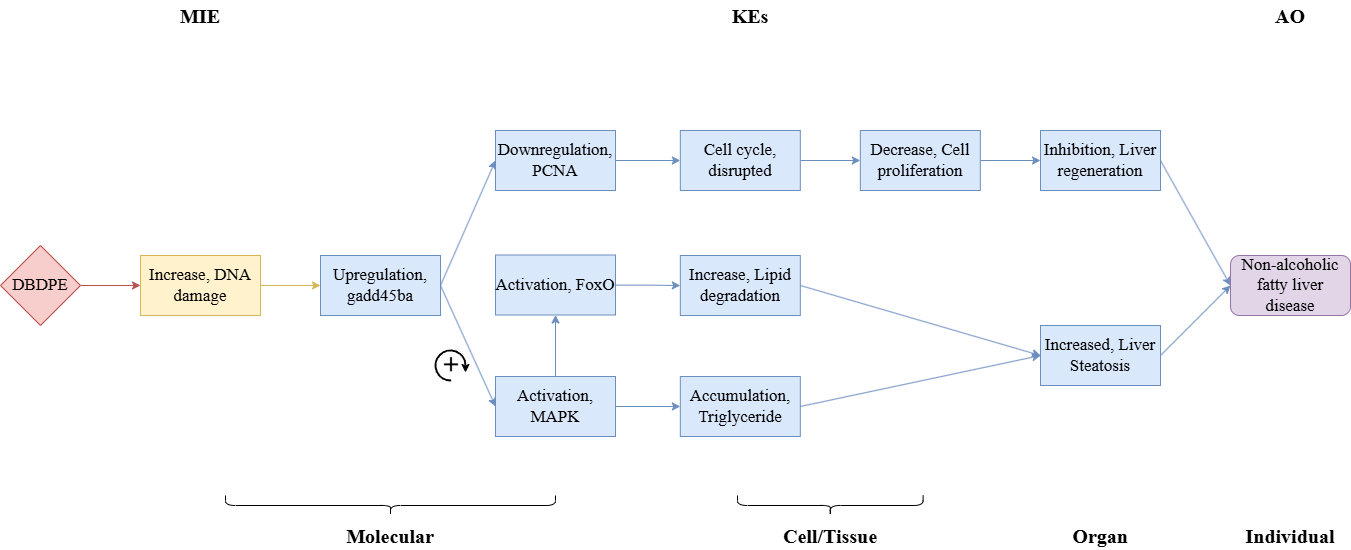
Decabromodiphenyl ethane (DBDPE), a widely used industrial substitute for polybrominated diphenyl ethers (PBDEs), acts as a significant environmental stressor. Exposure of zebrafish (Danio rerio) larvae to high concentrations of DBDPE (100 nM) causes an increase in DNA damage. This damage serves as the molecular initiating event (MIE), triggering a cascade of downstream effects.
The elevated DNA damage induces gadd45ba upregulation by p53 (Liebermann et al., 2008), which in turn activates the MAPK signaling pathway; Furthermore a positive feedback loop may further amplify this signal and subsequently activate the FoxO pathway (Li et al., 2023; Liebermann et al., 2008; Takekawa et al., 1998; Yang et al., 2009). Within this cascade, gadd45ba also binds directly to Proliferating Cell Nuclear Antigen (PCNA) which decreases its level (Chen et al., 1995). The resulting downregulation of PCNA disrupts the cell cycle (Li et al., 2023; Strzalka et al., 2011; Xu et al., 2016), leading to inhibited cell proliferation and further impaired liver regeneration (Li et al., 2023; Salehi et al., 2013).
In addition to affecting cell proliferation, the activated MAPK, which in turn activates the FoxO pathway (Essers et al., 2004; Exil et al., 2014) also disrupt lipid metabolism. MAPK signaling upregulates dgat1a causing triglyceride (TG) accumulation (Li et al., 2023, 2025). The FoxO pathway contributes by mediating the expression of related enzyme and genes, which promotes lipid degradation (Chakrabarti et al., 2009; Zhou et al., 2024). Together, the accumulation of TG and altered lipophagy result in hepatic steatosis (Zechner et al., 2017).
The development of hepatic steatosis (Dyson et al., 2014), coupled with an impaired capacity for liver regeneration (Fazia et al., 2018), ultimately leads to non-alcoholic fatty liver disease (NAFLD). This pathology represents the final adverse outcome of the pathway.
AOP Development Strategy
Context
This AOP is developed for zebrafish embryos exposed up to 120 hpf at the larval stage and 4 month old transgenic female zebrafish or wild-type female zebrafish. It provides novel insight into the toxic mechanisms of DBDPE as well as other emerging pollutants.
Strategy
Summary of the AOP
Events:
Molecular Initiating Events (MIE)
Key Events (KE)
Adverse Outcomes (AO)
| Type | Event ID | Title | Short name |
|---|
| MIE | 1194 | Increase, DNA damage | Increase, DNA Damage |
| KE | 2344 | Upregulation, growth arrest and DNA-damage-inducible beta a | Upregulation, gadd45ba |
| KE | 2345 | Activation, MAPK | Activation, MAPK |
| KE | 1293 | Activation, FOXO | Activation, FOXO |
| KE | 2346 | Decrease, Proliferating Cell Nuclear Antigen | Downregulation, PCNA |
| KE | 1505 | Increase, Cell cycle disruption | Cell cycle disruption |
| KE | 1821 | Decrease, Cell proliferation | Decrease, Cell proliferation |
| KE | 291 | Accumulation, Triglyceride | Accumulation, Triglyceride |
| KE | 2347 | Increase, Lipid degradation | Increase, Lipid degradation |
| KE | 459 | Increase, Liver steatosis | Increase, Liver steatosis |
| KE | 2348 | Inhibition, Liver regeneration | Inhibition, Liver regeneration |
| AO | 2019 | Non-alcoholic fatty liver disease | Non-alcoholic fatty liver disease |
Relationships Between Two Key Events (Including MIEs and AOs)
| Title | Adjacency | Evidence | Quantitative Understanding |
|---|
Network View
Prototypical Stressors
Life Stage Applicability
| Life stage | Evidence |
|---|---|
| Larvae | High |
| Adult | High |
Taxonomic Applicability
| Term | Scientific Term | Evidence | Link |
|---|---|---|---|
| zebrafish | Danio rerio | High | NCBI |
Sex Applicability
| Sex | Evidence |
|---|---|
| Female | High |
Overall Assessment of the AOP
Domain of Applicability
The research is conducted on zebrafish embryos up to 120 hpf, transitioning from the embryo to larval stage and 4 month old transgenic female zebrafish or wild-type female zebrafish..
Essentiality of the Key Events
Evidence Assessment
KER1 Increase, DNA damage lead to Upregulation, gadd45ba
gadd45ba which is growth arrest and DNA-damage-inducible beta a, will be upregulated when the DNA is impaired to repair the DNA (Liebermann et al., 2008).
KER2 Upregulation, gadd45ba lead to Activation, MAPK(Han et al., 2020)
In vivo, many experiments and evidence have shown that the GADD45 can mediated MAPK signal pathway (Li et al., 2023; Liebermann et al., 2008; Takekawa et al., 1998; Yang et al., 2009). When the stressor activate the Gadd45 upregulated by p53, it will bind to the MTK1 and activate the downstream p38/JNK. Further, the p53 will be upregulated by p38, which will form a positive feedback loop between Gadd45ba and MAPK signaling pathway (Han et al., 2020).
KER3 Upregulation, gadd45ba lead to Decrease, PCNA
The Gabb45 have the ability to directly bind to the PCNA which will disrupt its function in cell cycles(Chen et al., 1995).
KER4 Decrease, PCNA lead to Cell cycle, disrupted
PCNA which is Proliferating Cell Nuclear Antigen, have crucial role in cell cycle that is tightly linked to cell proliferation(Strzalka et al., 2011). The Decrease of PCNA will disrupt the cell cycle progression(Li et al., 2023; Xu et al., 2016).
KER5 Cell cycle, disrupted lead to Decrease, Cell proliferation
KER6 Decrease, Cell proliferation lead to Inhibition, Liver regeneration
The liver regenerates through cell proliferation, but this regenerative capacity is impaired when the process is inhibited by stressors(Li et al., 2023; Salehi et al., 2013).
KER7 Inhibition, Liver regeneration lead to Non-alcoholic fatty liver disease
The failure of liver regeneration will accelerate the disease progression in fatty liver, which may lead to the Non-alcoholic fatty liver disease(Fazia et al., 2018).
KER8 Activation, MAPK lead to Activation, FOXO
The MAPK and FoxO signaling pathways have many multiple regulatory mechanisms, remarkably, when p38 inhibited by inhibitor in exposed to Mn, the FoxO level also reduced(Exil et al., 2014). What’s more, c-Jun N-terminal Kinase (JNK) in MAPK family activated by cell stress can increase Foxo transcription (Essers et al., 2004).
KER9 Activation, MAPK lead to Accumulation, Triglyceride
The p38 in MAPK can regulate the TG biosynthesis through DGAT1 and PLINs, which will results in accumulation of TG in the cell(Li et al., 2023, 2025).
KER10 Activation, FOXO lead to Increase, Lipid degradation
FoxO signaling pathways have been proved to have the ability to promotes lipolysis and lipophagy which are processes of lipid degradation. In 3T3-L1 adipocyte, knockdown of FoxO1 will decrease the rate-limiting lipolytic enzyme which slow down the lipolysis(Chakrabarti et al., 2009; Zechner et al., 2017). Also, under the inhibitor of foxo1 in zebrafish liver show the lipid accumulation (Zhou et al., 2024).
KER11 Accumulation, Triglyceride lead to Increased, Liver Steatosis
KER12 Increase, Lipid degradation lead to Increased, Liver Steatosis
Lipid degradation will enhanced free fatty acid release from adipose tissues, which will contribute to the development of hepatic steatosis (Zechner et al., 2017).
KER14 Increased, Liver Steatosis lead to Non-Alcoholic fatty liver disease
Non-alcoholic fatty liver disease (NAFLD) is characterized by hepatic steatosis (>5% of hepatocytes) in the absence of significant alcohol use (Dyson et al., 2014).
Known Modulating Factors
| Modulating Factor (MF) | Influence or Outcome | KER(s) involved |
|---|---|---|
Quantitative Understanding
Considerations for Potential Applications of the AOP (optional)
References
Chakrabarti P, Kandror K V, 2009. FoxO1 Controls Insulin-dependent Adipose Triglyceride Lipase (ATGL) Expression and Lipolysis in Adipocytes[J]. The Journal of Biological Chemistry, 284(20): 13296-13300.
Chen I T, Smith M L, O’Connor P M, et al., 1995. Direct interaction of Gadd45 with PCNA and evidence for competitive interaction of Gadd45 and p21Waf1/Cip1 with PCNA[J]. Oncogene, 11(10): 1931-1937.
Dyson J K, Anstee Q M, McPherson S, 2014. Non-alcoholic fatty liver disease: a practical approach to diagnosis and staging[J]. Frontline Gastroenterology, 5(3): 211-218.
Essers M A G, Weijzen S, de Vries-Smits A M M, et al., 2004. FOXO transcription factor activation by oxidative stress mediated by the small GTPase Ral and JNK[J]. The EMBO journal, 23(24): 4802-4812.
Exil V, Ping L, Yu Y, et al., 2014. Activation of MAPK and FoxO by manganese (Mn) in rat neonatal primary astrocyte cultures[J]. PloS One, 9(5): e94753.
Fazia M A D, Servillo G, 2018. Foie gras and liver regeneration: a fat dilemma[J]. Cell Stress, 2(7): 162-175.
Han S, Wang Y, Ma J, et al., 2020. Sulforaphene inhibits esophageal cancer progression via suppressing SCD and CDH3 expression, and activating the GADD45B-MAP2K3-p38-p53 feedback loop[J]. Cell Death & Disease, 11(8): 713.
Li F, Song G, Wang X, et al., 2023. Evidence for Adverse Effects on Liver Development and Regeneration in Zebrafish by Decabromodiphenyl Ethane[J]. Environmental Science & Technology, 57(48): 19419-19429.
Li N, Saitou M, Atilla-Gokcumen G E, 2025. The Role of p38 MAPK in Triacylglycerol Accumulation during Apoptosis[J].
Liebermann D A, Hoffman B, 2008. Gadd45 in stress signaling[J]. Journal of Molecular Signaling, 3: 15.
Salehi S, Brereton H C, Arno M J, et al., 2013. Human liver regeneration is characterized by the coordinated expression of distinct microRNA governing cell cycle fate[J]. American Journal of Transplantation: Official Journal of the American Society of Transplantation and the American Society of Transplant Surgeons, 13(5): 1282-1295.
Strzalka W, Ziemienowicz A, 2011. Proliferating cell nuclear antigen (PCNA): a key factor in DNA replication and cell cycle regulation[J]. Annals of Botany, 107(7): 1127-1140.
Takekawa M, Saito H, 1998. A Family of Stress-Inducible GADD45-like Proteins Mediate Activation of the Stress-Responsive MTK1/MEKK4 MAPKKK[J]. Cell, 95(4): 521-530.
Xu Y, Chen B, Zheng S, et al., 2016. IgG silencing induces apoptosis and suppresses proliferation, migration and invasion in LNCaP prostate cancer cells[J]. Cellular & Molecular Biology Letters, 21: 27.
Yang Z, Song L, Huang C, 2009. Gadd45 Proteins as Critical Signal Transducers Linking NF-κB to MAPK Cascades[J]. Current cancer drug targets, 9(8): 915-930.
Zechner R, Madeo F, Kratky D, 2017. Cytosolic lipolysis and lipophagy: two sides of the same coin[J]. Nature Reviews Molecular Cell Biology, 18(11): 671-684.
Zhou Y, Li F, Fu K, et al., 2024. Bis(2-ethylhexyl)-2,3,4,5-tetrabromophthalate Enhances foxo1-Mediated Lipophagy to Remodel Lipid Metabolism in Zebrafish Liver[J]. Environmental Science & Technology, 58(10): 4581-4593.