
This AOP is licensed under the BY-SA license. This license allows reusers to distribute, remix, adapt, and build upon the material in any medium or format, so long as attribution is given to the creator. The license allows for commercial use. If you remix, adapt, or build upon the material, you must license the modified material under identical terms.
AOP: 606
Title
Ecdysone receptor antagonism leading to mortality via inhibition of chitin synthase 1
Short name
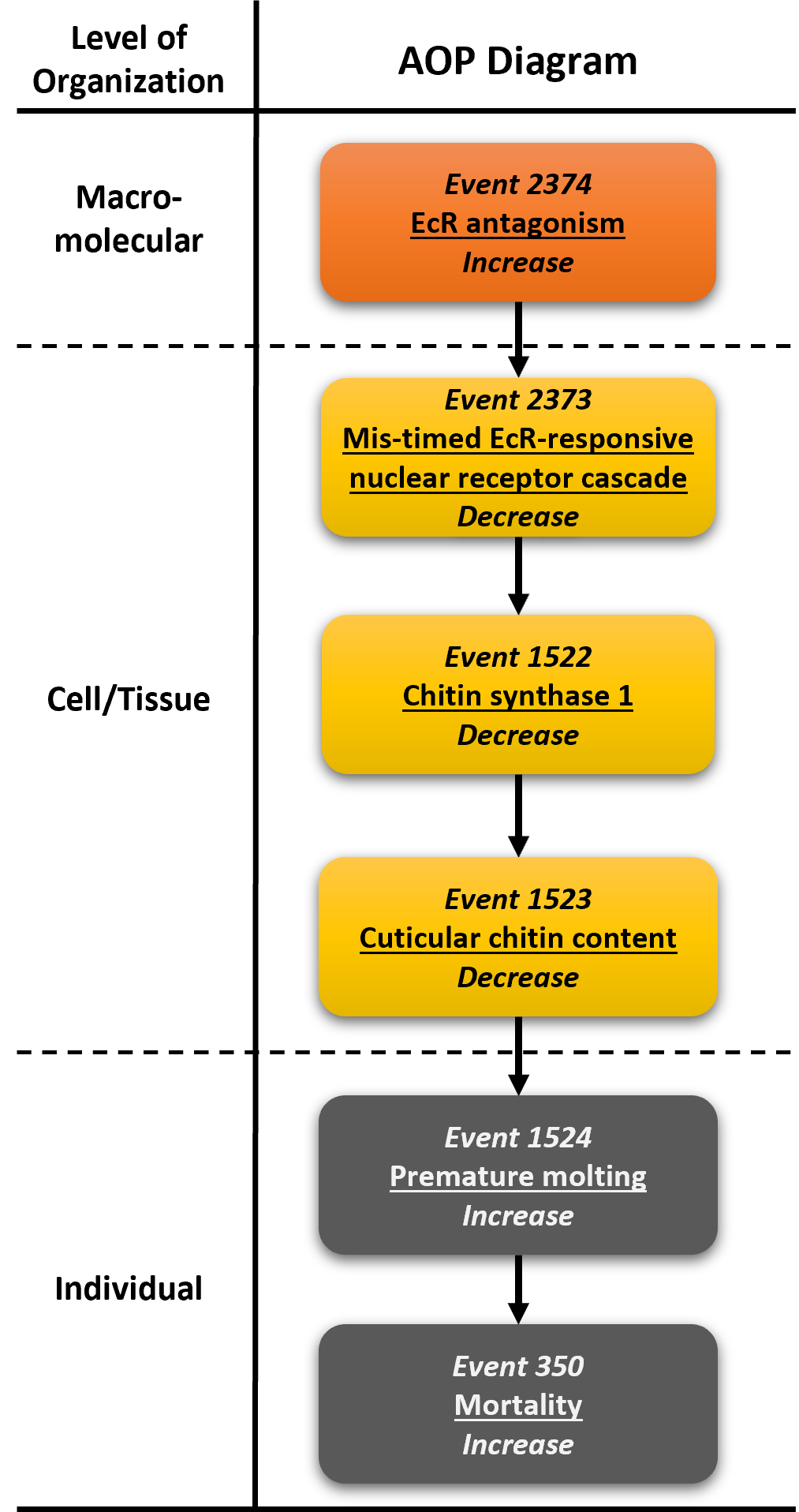
Graphical Representation
Additional AOP Exploration Options
Click links below to explore AOP 606, Ecdysone receptor antagonism leading to mortality via inhibition of chitin synthase 1 in tools offered by third parties.

Point of Contact
Contributors
- You Song
Coaches
OECD Information Table
| OECD Project # | OECD Status | Reviewer's Reports | Journal-format Article | OECD iLibrary Published Version |
|---|---|---|---|---|
This AOP was last modified on October 01, 2025 15:54
Revision dates for related pages
| Page | Revision Date/Time |
|---|---|
| Increase, Ecdysone receptor antagonism | September 29, 2025 05:17 |
| Decrease, Mis-timed ecdysone receptor-responsive nuclear receptor cascade | September 29, 2025 05:18 |
| Inhibition, Chitin synthase 1 | February 24, 2021 04:41 |
| Decrease, Cuticular chitin content | February 17, 2021 05:37 |
| Increase, Premature molting | February 17, 2021 05:30 |
| Increase, Mortality | October 26, 2020 05:18 |
| Increase, EcR antagonism leads to Decrease, Mis-timed EcR-responsive NR cascade | September 29, 2025 05:19 |
| Decrease, Mis-timed EcR-responsive NR cascade leads to Inhibition, CHS-1 | September 29, 2025 08:20 |
| Inhibition, CHS-1 leads to Decrease, Cuticular chitin content | February 17, 2021 07:50 |
| Decrease, Cuticular chitin content leads to Increase, Premature molting | February 17, 2021 08:20 |
| Increase, Premature molting leads to Increase, Mortality | February 17, 2021 08:47 |
| Cucurbitacin B | October 01, 2025 07:13 |
| Cucurbitacin D | October 01, 2025 07:13 |
| Ketoconazole | May 02, 2017 11:08 |
Abstract
This Adverse Outcome Pathway (AOP) describes how antagonism of the ecdysone receptor (EcR) disrupts endocrine signaling in arthropods, leading to premature molting and mortality. EcR is a nuclear receptor that mediates transcriptional responses to ecdysteroids, which regulate cuticle synthesis, chitin deposition, and developmental transitions. Inhibition of EcR prevents normal progression of the ecdysteroid-responsive nuclear receptor cascade, leading to reduced expression of chitin synthase 1 and reduced cuticular chitin content. These molecular and cellular disruptions compromise the structural integrity of the exoskeleton and trigger premature or defective molting. Ultimately, this leads to organism-level mortality. This AOP provides a mechanistic framework for assessing the hazard potential of EcR antagonists, supporting regulatory efforts to evaluate risks to non-target arthropods.
AOP Development Strategy
Context
EcR antagonists include experimental endocrine disruptors and potential environmental contaminants that interfere with steroid signaling in arthropods. Although most registered insecticides act as EcR agonists, antagonists represent a plausible mode of endocrine disruption with ecological significance. Understanding how inhibition of EcR leads to organismal failure provides a basis for chemical safety assessment.
Strategy
The AOP was developed using targeted literature reviews of EcR function, chitin biosynthesis, and molting regulation in insects and crustaceans. Searches in PubMed, Web of Science, and Scopus were conducted using terms such as ecdysone receptor antagonist, chitin synthase, cuticle formation, premature molting, and ecdysteroid signaling disruption. Empirical studies in Drosophila melanogaster, Manduca sexta, lepidopteran pests, and crustaceans informed the selection of key events (KEs) and their relationships. Expert input and prior reviews of molting endocrinology were used to frame the AOP in a regulatory context.
Summary of the AOP
Events:
Molecular Initiating Events (MIE)
Key Events (KE)
Adverse Outcomes (AO)
| Type | Event ID | Title | Short name |
|---|
| MIE | 2374 | Increase, Ecdysone receptor antagonism | Increase, EcR antagonism |
| KE | 2375 | Decrease, Mis-timed ecdysone receptor-responsive nuclear receptor cascade | Decrease, Mis-timed EcR-responsive NR cascade |
| KE | 1522 | Inhibition, Chitin synthase 1 | Inhibition, CHS-1 |
| KE | 1523 | Decrease, Cuticular chitin content | Decrease, Cuticular chitin content |
| AO | 1524 | Increase, Premature molting | Increase, Premature molting |
| AO | 350 | Increase, Mortality | Increase, Mortality |
Relationships Between Two Key Events (Including MIEs and AOs)
| Title | Adjacency | Evidence | Quantitative Understanding |
|---|
| Increase, EcR antagonism leads to Decrease, Mis-timed EcR-responsive NR cascade | adjacent | Moderate | |
| Decrease, Mis-timed EcR-responsive NR cascade leads to Inhibition, CHS-1 | adjacent | Moderate | |
| Inhibition, CHS-1 leads to Decrease, Cuticular chitin content | adjacent | Moderate | |
| Decrease, Cuticular chitin content leads to Increase, Premature molting | adjacent | Moderate | |
| Increase, Premature molting leads to Increase, Mortality | adjacent | Moderate |
Network View
Prototypical Stressors
Life Stage Applicability
| Life stage | Evidence |
|---|---|
| Juvenile | High |
| Adult | High |
Taxonomic Applicability
| Term | Scientific Term | Evidence | Link |
|---|---|---|---|
| Arthropoda | Arthropoda | High | NCBI |
Sex Applicability
| Sex | Evidence |
|---|---|
| Unspecific | Moderate |
Overall Assessment of the AOP
The overall weight of evidence supporting this AOP is strong, with high biological plausibility and consistent empirical data linking EcR antagonism to premature molting and mortality. EcR is a well-characterized nuclear receptor that orchestrates the ecdysteroid-responsive transcriptional cascade necessary for normal cuticle formation and molting. Antagonism of this receptor is expected to impair downstream gene expression, including chitin synthase 1, leading to reduced chitin deposition in the cuticle. These disruptions compromise the integrity of the exoskeleton and destabilize the timing of developmental transitions, resulting in premature molting events that are incompatible with survival.
Essentiality of the key events is well supported: genetic knockouts, RNAi knockdowns, and pharmacological inhibition of EcR or chitin synthase all produce the predicted downstream outcomes, culminating in lethality. Empirical support across taxa (insects, crustaceans) demonstrates that the mechanistic linkages are conserved within arthropods. Although quantitative understanding of dose–response relationships and thresholds for molting disruption remains limited, the coherence of the biological mechanism, reproducibility of the outcome, and conservation of the underlying pathways provide high confidence in the reliability of this AOP.
Given its strong biological plausibility and empirical support, this AOP has clear regulatory relevance for evaluating the risks of chemicals with EcR antagonistic properties. While further quantitative studies would enhance predictive applications, the current evidence base is sufficient to support use in chemical screening, prioritization, and ecological risk assessment of non-target arthropods.
Domain of Applicability
The domain of applicability of this AOP is defined primarily by the biology of the ecdysone receptor (EcR) and the molting process. Because EcR signaling and chitin biosynthesis are highly conserved within arthropods, this AOP is broadly relevant across multiple taxa, developmental stages, and environmental contexts.
-
Taxonomic applicability:
-
Insects: Strong evidence is available for holometabolous insects (Drosophila melanogaster, Manduca sexta, Bombyx mori, Lepidopteran crop pests), where EcR function and its transcriptional cascade have been extensively studied. Hemimetabolous insects (e.g., locusts, cockroaches) also rely on EcR signaling, though fewer data are available for EcR antagonism specifically.
-
Crustaceans: Increasing evidence supports applicability in aquatic species (e.g., Daphnia magna, Carcinus maenas, Penaeus spp.), which undergo chitin-based molting under EcR regulation. Transcriptomic and physiological studies demonstrate conservation of EcR function and chitin synthase regulation.
-
Other arthropods: Applicability is expected in arachnids and myriapods, given the conserved role of EcR and chitin in exoskeleton formation, but direct empirical data remain scarce.
-
-
Sex applicability: The pathway is relevant to both sexes. EcR signaling and molting are not sex-specific processes; therefore, both male and female individuals are equally susceptible to antagonism.
-
Life-stage applicability: This AOP is most relevant to juvenile and larval stages undergoing active molting. Premature molting in these stages leads directly to impaired growth, developmental arrest, or death. In adults, EcR signaling plays reduced roles, although cuticular renewal processes may still be impacted in some taxa (e.g., crustacean molting cycles).
-
Environmental context: The AOP applies in both terrestrial and aquatic ecosystems, wherever arthropods are exposed to environmental contaminants with EcR antagonistic activity. Aquatic crustaceans are particularly vulnerable given their continuous molting cycles and exposure pathways.
In summary, the domain of applicability encompasses a broad range of arthropod taxa, both sexes, and primarily larval or juvenile stages. While most supporting evidence comes from model insects and select crustaceans, the high conservation of the underlying pathways supports a wide biological relevance of this AOP.
Essentiality of the Key Events
The essentiality of the key events (KEs) in this AOP is strongly supported by experimental manipulations, including genetic knockouts, RNA interference (RNAi), pharmacological inhibition, and rescue assays. Because molting is a tightly regulated process, disruption at any level of the EcR signaling–chitin synthesis axis produces predictable downstream consequences, culminating in lethality.
-
MIE: EcR antagonism
-
Evidence: EcR is the central nuclear receptor mediating ecdysteroid signaling. Competitive antagonists or dominant-negative EcR mutations prevent activation of downstream nuclear receptor genes (e.g., HR3, Ftz-f1).
-
Essentiality: High. Blocking EcR function prevents initiation of the molting transcriptional cascade. Restoration of EcR function rescues normal molting.
-
-
KE: Decreased EcR-responsive transcriptional cascade
-
Evidence: Knockdown of EcR or RXR/USP (the EcR heterodimer partner) leads to broad suppression of ecdysteroid-responsive genes, including those necessary for cuticle synthesis.
-
Essentiality: High. These nuclear receptors act as competence factors for molting; without their activation, progression to chitin synthase induction and cuticle deposition is blocked.
-
-
KE: Decreased chitin synthase 1 expression
-
Evidence: RNAi knockdown of chitin synthase genes in Drosophila and Tribolium results in defective cuticle formation, molting arrest, and lethality. In crustaceans, inhibition of chitin synthase similarly disrupts exoskeletal renewal.
-
Essentiality: High. Chitin synthase is the rate-limiting enzyme for polymerization of chitin; its disruption directly impairs cuticle formation.
-
-
KE: Decreased cuticular chitin content
-
Evidence: Pharmacological inhibitors of chitin synthesis (e.g., benzoylureas) and genetic knockdowns lead to reduced chitin levels and fragile cuticles. These effects consistently precede defective molting and mortality.
-
Essentiality: High. Adequate chitin deposition is indispensable for structural integrity of the exoskeleton.
-
-
KE: Increased premature molting
-
Evidence: Experimental reduction of chitin synthesis or EcR signaling often triggers mistimed molts, which are non-viable. Rescue of chitin deposition (e.g., by overexpression of chitin synthase) prevents premature molting in experimental systems.
-
Essentiality: High. Premature or defective molting is directly incompatible with survival in arthropods.
-
-
AO: Mortality
-
Evidence: Mortality is the inevitable outcome of premature or incomplete molting, as arthropods cannot survive without shedding the old cuticle and forming a new one. This has been repeatedly observed in laboratory and field studies with EcR-targeting compounds.
-
Overall assessment: The essentiality of the key events in this AOP is considered high. Direct experimental manipulations at multiple points in the pathway (EcR function, nuclear receptor cascade, chitin synthase expression, chitin deposition) consistently demonstrate that disruption prevents progression to the next KE and results in mortality. Rescue studies further confirm causality. Together, these data provide strong confidence that the KEs in this AOP are indispensable for normal molting and survival.
Evidence Assessment
KER 2374 → 2373 (EcR antagonism → Decreased EcR-responsive cascade)
-
Biological plausibility: Strong; EcR is a master regulator of steroid-induced transcription.
-
Empirical support: Inhibitors of EcR block induction of nuclear receptor genes (e.g., HR3, Ftz-f1).
KER 2373 → 1522 (Decreased nuclear receptor cascade → Decreased chitin synthase 1 expression)
-
Biological plausibility: Strong; transcription of chitin synthase genes is steroid-dependent.
-
Empirical support: RNAi knockdown of nuclear receptor genes reduces chitin synthase expression in insects.
KER 1522 → 1523 (Decreased chitin synthase 1 → Decreased cuticular chitin content)
-
Biological plausibility: Strong; chitin synthase is the rate-limiting enzyme for chitin polymerization.
-
Empirical support: Chitin synthase knockdown or inhibition reduces chitin deposition in cuticle.
KER 1523 → 1524 (Decreased cuticular chitin → Increased premature molting)
-
Biological plausibility: Strong; reduced chitin weakens cuticle structure and destabilizes molt timing.
-
Empirical support: Experimental reduction in cuticular chitin triggers defective and premature molts.
KER 1524 → 350 (Premature molting → Mortality)
-
Biological plausibility: Strong; premature molting results in incomplete development, loss of protection, and organismal death.
-
Empirical support: Consistently observed in insects exposed to EcR inhibitors or with disrupted chitin biosynthesis.
Known Modulating Factors
-
Developmental stage: Premature molting occurs only if antagonism coincides with periods of ecdysteroid signaling during cuticle deposition.
-
Species differences: Variation in EcR isoforms and chitin metabolic pathways can modulate sensitivity. Lepidopterans and dipterans often show higher sensitivity.
-
Nutritional state: Energy and substrate availability for chitin biosynthesis (e.g., glucose, UDP-N-acetylglucosamine pools) modulate outcomes.
-
Environmental factors: Temperature and humidity affect cuticle synthesis and molting success.
-
Chemical properties: Antagonist potency, receptor affinity, and bioavailability influence the severity and timing of KE progression.
| Modulating Factor (MF) | Influence or Outcome | KER(s) involved |
|---|---|---|
Quantitative Understanding
-
MIE (EcR antagonism): Binding affinities and antagonist activities for EcR have been documented for some chemicals (e.g., dibenzoylhydrazines in antagonist mode, experimental scaffolds), but quantitative receptor occupancy thresholds remain underdeveloped.
-
Nuclear receptor cascade → Chitin synthase: Genetic knockdown studies show strong temporal concordance; suppression of EcR target gene cascades reduces CHS1 expression. Quantitative dose–response data are limited.
-
Chitin synthase → Cuticular chitin: Experimental knockdown of CHS1 yields proportionally reduced chitin levels; threshold-like relationships exist where cuticle integrity is lost below critical chitin levels.
-
Cuticular chitin → Premature molting: Reduced chitin triggers incomplete or premature molting, a deterministic relationship supported by multiple insect models.
-
Premature molting → Mortality: Strong evidence that unsuccessful molts correlate with high mortality, often >80–90% in experimental studies.
Overall confidence: Moderate to high for qualitative predictions, moderate for quantitative extrapolation. More targeted data are needed to establish predictive quantitative KERs.
Considerations for Potential Applications of the AOP (optional)
This AOP provides a mechanistic framework that can be applied in several regulatory and scientific contexts related to the hazard and risk assessment of chemicals with EcR antagonistic activity. Because EcR is a central regulator of arthropod molting, disruption of its signaling cascade has direct consequences on survival and population dynamics. Thus, this AOP can be applied across multiple levels of chemical assessment, ranging from early screening to ecological risk evaluation.
1. Screening and Prioritization of Chemicals The AOP identifies EcR antagonism as a molecular initiating event that can be probed with receptor-binding assays, reporter gene systems, or in silico docking models. These methods can be used in high-throughput screening programs to prioritize chemicals for further testing. Chemicals showing EcR antagonist activity could be flagged for potential concern regarding non-target arthropods.
2. Support for Test Guideline Development and Refinement This AOP highlights specific endpoints such as EcR-responsive gene expression, chitin synthase 1 expression, and cuticular chitin deposition, which could be integrated into OECD test guidelines or used as biomarkers in modified protocols. These endpoints offer mechanistic markers that can provide early evidence of adverse outcomes before organismal lethality occurs.
3. Integrated Approaches to Testing and Assessment (IATA) The pathway offers opportunities to combine in vitro assays, transcriptomic biomarkers, and cuticle composition measurements with in vivo molting assays to create tiered assessment strategies. Such approaches can reduce reliance on animal testing, while still ensuring regulatory robustness by linking molecular and cellular endpoints to organismal outcomes.
4. Grouping and Read-Across The mechanistic understanding of EcR antagonism can support grouping of chemicals with similar structural or functional properties. This enables the use of read-across approaches in regulatory submissions, where data from one compound can be applied to structurally related analogues. In addition, development of (Q)SAR models based on chemical structural features associated with EcR antagonism can be informed by this AOP.
5. Ecological Risk Assessment Because molting is essential for arthropod growth and reproduction, disruption of this process has direct implications for population dynamics and ecosystem function. This AOP provides a scientifically supported mechanistic link between receptor-level antagonism and mortality, which can be used in ecological risk assessment frameworks. This is particularly relevant for assessing risks of environmental contaminants to non-target aquatic crustaceans and beneficial insects such as pollinators.
6. Regulatory Decision-Making Regulators can use this AOP as part of weight-of-evidence evaluations for chemicals suspected to interfere with arthropod endocrine systems. The structured mechanistic evidence can be applied to inform decisions on chemical approval, restriction, or mitigation measures aimed at protecting non-target species.
Overall, this AOP strengthens the scientific basis for linking molecular and cellular perturbations to adverse ecological outcomes, and supports the transition toward more predictive and mechanistically informed regulatory toxicology.